‘Take some risks’: Bloom & Wild on building the ‘confidence’ to invest in brand
Bloom & Wild is leaning on emotional resonance with a new campaign aimed at driving profitable growth, as the brand backs its ability to invest.

 Bloom & Wild is a business “confident” in its ability to invest in brand, with “great momentum” helping the business deliver profitable growth.
Like many ecommerce brands, the flower and gifting delivery firm embarked on a period of recalibration post-pandemic. As a consequence, post-Covid the brand zoned in on profitability rather than chasing growth.
The business has since returned to profitable growth, delivering 5.9% revenue growth in its fiscal year ending 31 March 2025. Bloom & Wild has also successfully driven improved profitability, with adjusted EBITDA rising from £4.1m in 2024 to £5.7m during its most recent fiscal year.
While the business did maintain investment behind its brand even as it focused on profitability, CMO Charlotte Langley explains Bloom & Wild has entered a stage where it is very “confident” in investing behind its brand.
Earning the ‘right to invest’: Bloom & Wild on driving growth with ‘guardrails’
“That allows us to invest even more into the future of the brand and the business,” she says.
The UK business delivered 10% revenue growth in its 2025 fiscal year (ending 31 March 2025), with revenue growth in the first half of its 2026 fiscal year (up to September 2025) having more than doubled to 21%.
Given the commercial performance, Langley explains the time is right for Bloom & Wild to invest in a new brand campaign under its ‘Care Wildly’ platform. Launching today (29 January), the campaign looks to build on the emotional connection with consumers.
The previous ad under the platform was developed in the Covid-era and has run for several years. The “emotional context” has evolved since then, says Langley.
“This felt like an opportunity to just refresh that and take a slightly different approach,” she adds.
Not just about occasions
As a flower and gifting brand, occasions like Mother’s Day, Valentine’s Day and birthdays are very important to Bloom & Wild. However, it is also important for the brand to capture smaller, but no less important occasions.
“Caring wildly isn’t just about the occasions marked in the calendar,” Langley says.
For this reason, it was important not to portray a big calendar moment in the ad, but instead to capture those more “overlooked” moments where consumers use the brand to gift loved ones, she explains.
The latest iteration ‘Empty Nest’, created by agency The Or, follows the emotions of a mother whose youngest child has left home. The creative shows the mother receiving a bunch of Bloom & Wild flowers as she puts the empty bedroom of her child to good use hosting a life drawing class with friends.
For me, more than the metrics, it’s about whether people watch the ad and say: ‘Oh, I really understand that.’
Charlotte Langley, Bloom & Wild
While the ad portrays a moment that is more specific than Mother’s Day or Valentine’s Day, Langley says its emotional resonance is broad.
“In the end, it depicts a lot more strongly what we’re trying to say about the relationships between the customers,” she notes.
When it comes to judging the success of the ad, Bloom & Wild will look to measure the reach and impact of the TV advert. The brand uses econometric modelling to gauge the impact of the ad on longer-term measures.
Alongside the formal metrics, Langley explains emotional resonance is top of her priority list.
Emotional brand-building can help a little more budget go a long way
“For me, more than the metrics, it’s about whether people watch the ad and say: ‘Oh, I really understand that,’” she says. “That they can see one of their relationships through what we’re showing in this ad.”
In pre-testing, consumers reacted well to the emotional messaging, with those who had seen it more likely to perceive Bloom & Wild as a “thoughtful” brand or one that “helps you express how you care”.
The previous iteration of the Care Wildly platform ran for several years and Bloom & Wild hopes the new creative will have similar longevity.
“Clearly, making ads is an expensive business and we have thought very carefully about this one, and done a lot of focus group work and quantitative testing as well to make sure that we feel this story is going to resonate,” Langley says.
Gifting as a ‘core driver of growth’
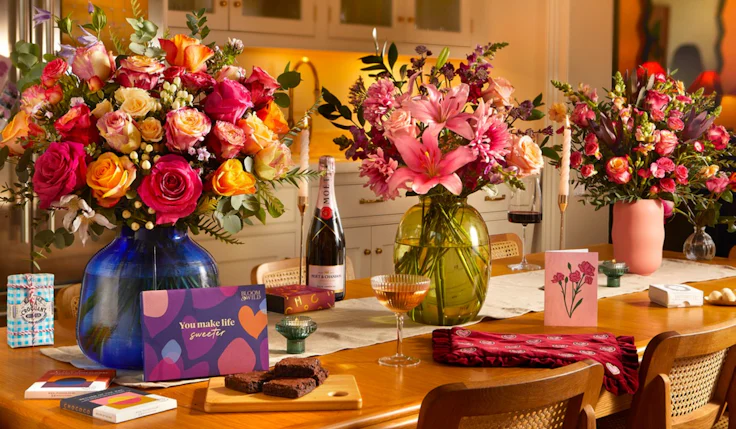
Despite its brand name being distinctly floral, gifting beyond flowers has become an increasingly important part of Bloom & Wild’s business.
The company’s 2025 fiscal year report states gifting has now “transitioned from a new initiative to a core revenue stream”, with the brand having expanded its offering to include baked goods, food hampers and gift sets.
Bloom & Wild terms gifting a “core driver of growth”, with the proposition driving incremental revenue, particularly through driving repeat purchase. However, despite the growth in gifting, the new ad only features flowers.
“We decided to be single minded and focus on flowers for this particular ad,” says Langley.
She explains it made sense to centre the creative on a single product to create the “narrative arc” the brand is after. Furthermore, as Bloom & Wild approaches the peaks of Mother’s Day and Valentine’s Day in the coming months, it makes sense to focus on the flower business, the CMO adds.
You definitely have to take some risks. When you do something new, by definition it’s not proven.
Charlotte Langley, Bloom & Wild
“What that doesn’t mean is that we’re not focusing on gifting in other spaces and during other times of year,” she states.
Consumers will start to see the gifting proposition crop up on other channels and during peaks for that side of the business, such as Christmas. The gifting business is also an important frequency driver for Bloom & Wild, meaning ads recruiting people into the flower business also benefit the gifting side.
However, Langley is keen to stress Bloom & Wild doesn’t just offer gifting as a bolt-on.
“It’s really important to say the broader gifting business is not just stuff that you add to flowers,” she says.
The brand recognises it has a job to do to continue to drive awareness of its gifting proposition.
“From our advertising effectiveness measurement at the moment, what we know is the best way for us to do that is to focus on our repeat customers and build it that way, versus going out into the market with lots of acquisition ads purely focused on the gifting business,” Langley explains.
Core versus more
Bloom & Wild has entered an era where it can invest confidently in its brand and gradually scale those investments over time. However, the marketing team are cautious to invest behind growth with “responsibility”, says Langley. She previously told Marketing Week about using metrics to determine “guardrails” for driving growth to ensure it’s done profitably.
The business also recognises the necessity to take some level of risk to expand into new areas.
“You definitely have to take some risks,” says Langley. “When you do something new, by definition it’s not proven.”
Diageo on why ‘celebrating the kills’ helps to de-risk innovation
For example, when the brand was building its gifting business it “went quite cautiously” to begin with, before building momentum and “getting into a positive loop” with investment.
As well as its home market of the UK, Bloom & Wild also has a presence in Germany. Langley encourages her team to “have two different hats” in the markets.
In the UK, the brand is at the stage where it can run large brand campaigns, having established itself in the market. Whereas in Germany, the brand leans more on partnerships, as well as taking a test-and-lean approach.
“There are certainly things that we have done, small activities that perhaps we wouldn’t repeat, but that’s fine,” says Langley. “That’s all part of learning what the right mix is.”