Why OpenAI is making the UK a marketing ‘centre of excellence’
OpenAI’s UK-based international marketing team will serve as the blueprint for rolling out global marketing hubs.
 By Molly Innes
 Some might argue OpenAI was slow on the uptake with its marketing. ChatGPT was launched in late 2022, but it was two years later the business appointed its first chief marketing officer, Kate Rouch.
With 700 million weekly users worldwide, OpenAI is building its international marketing team to help the tech firm move beyond awareness. In the UK, ChatGPT usage has quadrupled in the last year, making it the perfect home to build its first international marketing team, explains international marketing director Elke Karsens.
She joined the business in March, following senior marketing roles at companies such as Coinbase and Facebook, with a brief to build a marketing team in London. This team, she says, will be a “centre of excellence” for the business.
OpenAI launches ChatGPT’s first major brand campaign
“[International] basically means anything that is not US-based. We can’t be everywhere at once, so the UK is where we’re starting,” Karsens explains.
The UK is one of OpenAI’s fastest growing markets and “benefits from an incredibly deep pool of creative talents”, making it a natural launchpad for expansion. The work she’s been doing for the last six months culminated this week in ChatGPT’s first major brand campaign, which is rolling out across the UK, Ireland and US.
How did the team get here?
Building from scratch
OpenAI wants to use its UK-based international marketing team as a model for other regions when the time is right.
The business is starting off setting up the centre of excellence spanning creative, production and marketing expertise, which “hopefully, in time” will be replicated globally.
According to Karsens, success starts with the people initially hired for these types of roles. The team needs marketers with what she calls “international DNA”, meaning an understanding of how work can resonate in other markets.
She wants marketers who understand “what it takes for something to show up” globally. India, Japan and Korea are countries where the business is not yet marketing, but is “starting to think” about how it could show up. Indeed, OpenAI is currently hiring a marketing lead for Korea based in Seoul, and other roles in Japan and India.
“I definitely look for people that have that international DNA from an interest perspective, but obviously an experience perspective as well,” Karsens explains.
You want to get the right message in front of the right people at the right time, but how you get that message in front of people has radically changed.
Elke Karsens, OpenAI
She acknowledges OpenAI’s marketing function is “still relatively young”. Her team is split between consumer-focused activity to drive brand love and the B2B side.
“That basically means that we’re supporting the growth of the business through a lot of mid to lower funnel tactics and more generally our B2B revenue growth efforts,” she explains.
Recruiting the right talent is critical for any business growth. OpenAI as an organisation moves “at a certain pace” and operates in a certain way, says Karsens.
“It’s incredibly important that people are comfortable moving in a super-fast paced environment,” she adds.
While experience in fast moving companies is beneficial to her marketing team, it’s not the only thing she looks for when hiring. One of the main attributes is people who “have a really open mind and are not set in doing things a certain way”.
While marketing continues to evolve, and AI more broadly is having a big impact, the fundamentals remain.
‘Eroding trust’: Marketers debate the role for ‘AI-enhanced’ creative
“When you look back over the last 50 years, at the end of the day the job to be done was the same,” she says. “You want to get the right message in front of the right people at the right time, but how you get that message in front of people has radically changed.”
Marketing channels have proliferated. There are more options to consider and more to learn. When hiring marketers, Karsens wants people who are open to “experimenting” with new ways to reach customers.
“With AI being a new and transformative technology, there will be changes to how people’s jobs are done today, but it will also create new functions and jobs within that space too,” she says.
Regarding what those roles might look like, Karsens is “very much focused” on getting the foundations in place.
“I hire marketers, in market, that have a really good understanding at the market level, but I’m also looking and hiring people who have that creative ability, and that experience and are incredibly broad as well,” she adds.
Emotional connection
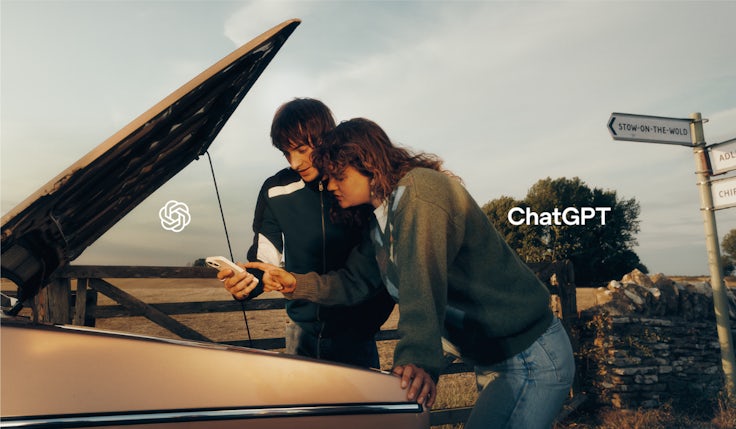
Interestingly, OpenAI has leant on a more traditional approach for its first major brand push. Broadcasting on TV, the campaign features emotionally resonant scenes, like a new couple sharing a meal prompted by ChatGPT. The creative was even filmed on 35mm and the business has emphasised the importance of human craft in the process.
For Karsens, it’s all about product-led storytelling “that builds really deep emotional connection”. To drive authenticity, the campaign is deliberately local to the UK, with scenes shot in Highgate in London and the Cotswolds.
This approach may be at odds with the many marketers either using AI in their campaigns, or worried AI tools like ChatGPT may make their jobs redundant.
The tool helped to streamline scheduling, internal reviews and approval processes, says Karsens.
“Fundamentally, we very much see AI not replacing creativity, but very much enhancing it,” she says.
“We really wanted to make sure that the work was all about showing and not telling, and in order to be authentic, we really wanted these stories to also reflect real moments. We shaped this with the highest level of craft.”
It’s a combination of ChatGPT powering the behind the scenes work to bring creativity to the fore, she explains, meaning “the combination of the two can create incredibly powerful work”.
In terms of how the company will measure the effectiveness of its brand push, it’s fair to say the AI giant doesn’t suffer from an awareness problem.
“We don’t have a ChatGPT awareness campaign, but we want to deepen that preference, so hopefully some of the data in time is going to see some movement there,” Karsens adds.