Specsavers CEO on why its main purpose is ‘not financial success’
Specsavers CEO says its main focus is “changing lives” and ensuring it acts in customers’ best interests, which if done right, will lead to financial success.

For Specsavers, brand purpose is a red-thread that runs throughout all of its operations, not just marketing.
The brand’s CEO John Perkins said it is “hugely important” for the business, and is “brought to life” through the stories of the “people’s lives we have improved”.
According to Perkins, Specsavers had the ability to propel the brand in 1983 when opticians were allowed to advertise for the first time, and the business name didn’t just have to be the name of the optician.
These changes led to the “birth of Specsavers’ purpose” as a brand, which Perkins describes as “trying to change lives through better sight and hearing”.
Having its founders Doug and Mary Perkins still involved in the business is also a benefit, he said, as they are “the personification of our purpose”.
As each Specsavers store is part-owned and managed by local opticians and audiologists, the core aspects of the brand’s purpose carry through to the hiring process, with each partner needing to “believe in every single thing that Specsavers stands for”, he said, to maintain brand consistency.
“The brand is sort of owned by the community, by customers”, as the people running each store have links to the local communities, said Perkins, who was talking at Marketing Week’s Festival of Marketing (2 October).
Perkins also claimed that having an “understanding” CFO helps to build the purpose of the brand, and stated “we’re very much of the mind that if we do the right things, and if we deliver our purpose, then financial success follows as a function of that”.
“Our purpose is not financial success. Our purpose is about changing lives, and actually the rest sort of follows,” he added, claiming that the brand is “lucky” it can “start by thinking about what’s in the best interest of customers” and “take that long-term perspective”.
None of the successful ‘Should’ve’ [campaigns] have ever been made other than in our in-house creative agency.
Peter Wright, Specsavers
Like with the CFO, the need to have a good relationship between CMO and CEO was highlighted by Perkins, who added that having the CMO role on the main board is important. Everyone on the main board has two hats, one being their “functional role”, and the other as a “business leader”, he said.
Perkins said the first thing he needs from the brand’s CMO, Peter Wright, is “the benefit of his insight” and his “business experience over many years” to help it “deal with the challenges and the opportunities that we experience”.
When it comes to marketing, rather than the day-to-day content, Perkins said he needs Wright to “think through really clearly, incredibly complicated situations” such as “how we evolve the Specsavers brand over the next 40 years” – alongside “patience”.
From his perspective, Wright needs “communication” from the CEO, which affects the way he communicates with the board.
“You’ve got to speak in the language of the business. It’s literally pointless for me to talk in marketing talk to the board or to John,” said Wright, adding that this needs to be translated to “simple speech”.
‘Top of mind’
Wright said the marketing team is able to excel because of the company’s “environment”, which allows people to be creative, and because of its in-house running of operations. Last year, he told Marketing Week about the need to create a “psychologically safe environment” for marketers to do their job.
“If you can create that environment where people fully feel as though they’re able to do their very best, they will produce things you never believed possible,” said Wright, citing the work from the brand’s social agency, which is left to “get stuff done” rather than requiring sign-off for everything.
Having its own in-house agency was also cited as a benefit by Wright, who said it means “you’ve got people who intuitively know the brand”.
“None of the successful ‘Should’ve’ [campaigns] have ever been made other than in our in-house creative agency,” claimed Wright.
Wright also said “being top of mind” is a key goal for marketing, as he recognises that its products are an “occasional purchase” that “you don’t really want to do a lot of the time”.
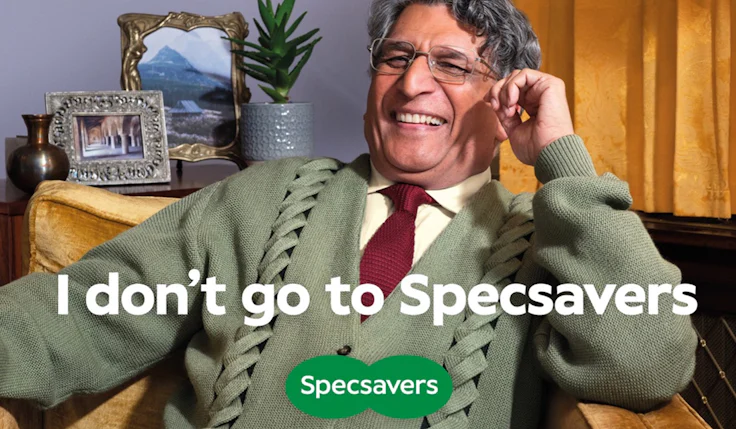
He said this is where the iconic strapline ‘Should’ve gone to Specsavers’ comes into play the most, and the “warm, human, open” approach makes sense to make the brand accessible to those who may be “nervous” about eye or hearing tests. Yet Perkins acknowledged that a challenge comes because “humour is personal”, and particular care needs to be taken when discussing healthcare matters.
Wright also noted the importance of keeping advertising “culturally relevant” and “media relevant”, with the team continually exploring how to move ideas into other forms of media, including social and digital.