Pitching processes, alcohol cutbacks, CMO to CEO: 5 interesting stats to start your week
We arm you with all the stats you need to tackle the week ahead.

Half of brands ran an agency pitching process last year
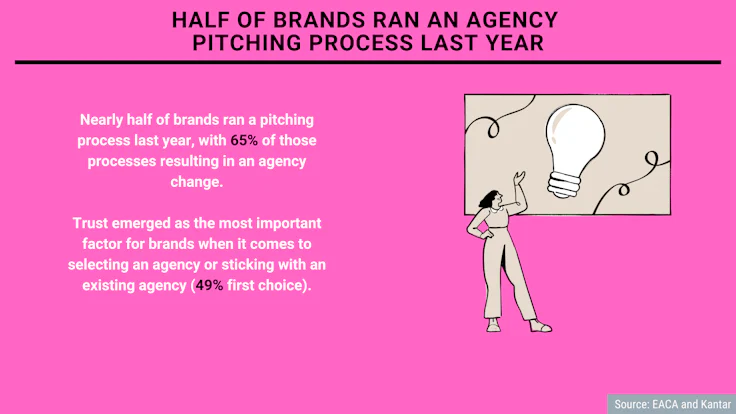
Research from the European Association of Communications Agencies (EACA) finds that nearly half of brands ran a pitching process last year, with 65% of those processes resulting in an agency change.
This frequent switching behaviour comes despite previous research of Effie Europe 2025 entries, which suggest that brand/agency partnerships lasting five years or more are considerably more successful in delivering effective work than shorter relationships.
The latest EACA research carried out with Kantar surveyed 141 companies working across 22 different markets. Trust emerged as the most important factor for brands when it comes to selecting an agency or sticking with an existing agency (49% first choice). Deep business involvement (41%) also emerged as highly important.
While a quarter (26%) of CMOs are ‘very satisfied’ with their existing agencies, nearly double (45%) are merely content or satisfied with their partnership.
Source: EACA and Kantar
Affordability is the main factor driving alcohol cutbacks
 January is often a time for consumers to prioritise health. However, price is the main factor driving consumers to cut down on their alcohol intake over the next 12 months, trumping health and wellbeing, according to research from MMR Research.
Nearly four in 10 (39%) consumers say they are cutting down on alcohol intake because of affordability, compared to just 22% who say they are reducing their intake due to health and fitness reasons.
A further 14% of consumers say they are cutting down on alcohol due to a desire for mindfulness.
Only 16% of consumers say they intend to top up their alcohol consumption over the next 12 months.
While, on seeing this data, alcohol marketers may be tempted to slash prices, the full view is more complex, says Andrew Wardlaw, MMR Research chief ideas officer.
“Across the board, we are seeing people becoming more purposeful and deliberate with their spending – and that intentionality only ramps up when purse strings are tight,” he says. “So, if an alcohol product doesn’t meet a particular need in their life, consumers are far less likely to see it as worth paying for.”
Source: MMR Research
One in 10 CMOs at top firms go on to be CEOs
 Around one in 10 CMOs who have departed their roles go on to become CEOs, according to analysis from leadership advisory firm Spencer Stuart.
The average tenure for CMOs at S&P 500 companies, an index of US companies with the highest stock market capitalisation, was just 4.1 years versus an average of five years for all C-suite roles.
However, the analysis suggests many of these CMOs may be departing to take on CEO or other high-level general management roles. Between 2021 and 2025, there were 218 CMO departures across these companies, of which 9% left to take on a CEO role and a further 13% became a divisional CEO/president or chief operating officer.
The analysis finds that nearly two-thirds (62%) either were promoted at their company or went on to a similar or bigger role at another company. Of those who depart their organisation, three-quarters (77%) land at a new company within six months.
Just under a third (31%) of S&P 500 companies have no CMO whatsoever. The research states that most of these companies do have some kind of marketing capability, but it might sit somewhere else on the organisation chart, with no marketing presence in the C-suite.
Source: Spencer Stuart
Data analysis and market research are most common AI uses
 AI is undoubtedly a huge priority for marketers, with 70% naming it as the most important consumer trend, according to research from Mediaocean.
However, when it comes to adoption of AI in their own work, marketers are much more likely to use it for research rather than in execution. Over two in five (43%) marketers are using AI for data analysis, with the same proportion using it for market research.
Significantly fewer marketers use AI as they get closer to execution, with a third (33%) using it for creative development and less than one in five (19%) utilising the technology for campaign orchestration.
When it comes to barriers to scaling AI effectively, data quality or access issues (42%) are cited as the biggest challenge, and difficulty connecting AI insight across systems (41%) is the next biggest issue.
Source: Mediaocean
A decade has passed since consumer confidence was in positive territory

UK consumer confidence has risen slightly in the wake of Christmas trading, but 2026 marks 10 years since a positive score was last recorded.
While the GfK Consumer Confidence Barometer powered by NIM shows a slight improvement in January, with the overall index score up one point to -16, it remains firmly in negative territory.
However, this is a rise of six points compared to January 2025, when the score was -22.
Yet, despite the slight rise, consumers still “remain unconvinced about the wider economic outlook”.
Neil Bellamy, consumer insights director at GfK, says consumers are “more cautious but also more self reliant” and are “once again focusing on what they can control”, which he defines as their “own spending and saving”.
He says this echoes “periods of political and economic uncertainty, most notably in late 2022”.
Source: GfK