Brand awareness, media investment, B2B customer journeys: 5 interesting stats to start your week
We arm you with all the numbers you need to tackle the week ahead.
CMOs increasingly viewing brand awareness as most important metric
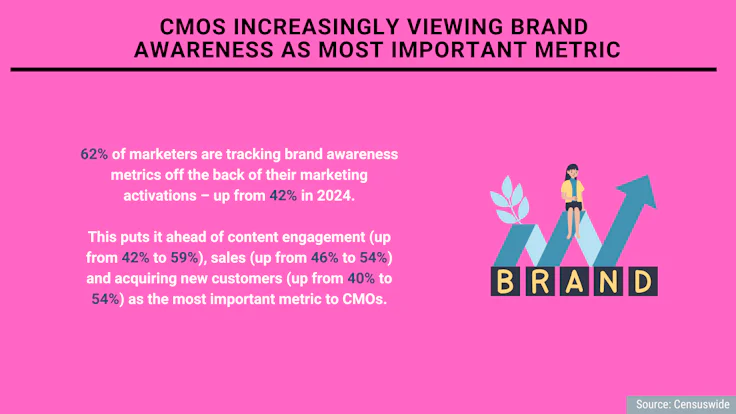
CMOs are placing greater importance on raising brand awareness than they were a year ago, according to new research from Censuswide.
Its ‘The Voice of the UK CMO’ report reveals that 62% are tracking brand awareness metrics off the back of their marketing activations – up from 42% in 2024.
This puts it ahead of content engagement (up from 42% to 59%), sales (up from 46% to 54%) and acquiring new customers (up from 40% to 54%) as the most important metric to CMOs.
The data shows that 89% of CMOs face budget challenges in 2025, with 39% saying their budget is already “saturated” with planned activity and 35% bemoaning having to do more with less.
Positively, though, the figures show that optimism is high for marketing budgets next year as 85% of CMOs expect to see their marketing budgets on the up in 2026.
Source: Censuswide
Over one in four marketers to cut spend on X
 Over a quarter (29%) of marketers plan to decrease spend on X, according to data from Kantar’s Media Reactions report. Nearly one in eight of those surveyed plan to pull their investment in the platform completely.
Kantar’s Media Reactions report ranks media channels based on both consumer and marketer preferences, however, on this occasion, no brand is in the top five across both groups.
The study is informed by the opinions of around 18,000 consumers covering 384 brands in 27 markets and 1,000 senior marketers around the world.
Amazon-owned brands dominate the consumer ranking, with Amazon in first place, Twitch in fourth and Prime Video in fifth. Both Twitch and Prime Video are new entries into the ranking entirely, demonstrating a rapid rise.
The other two brands in the consumer top five, Snapchat and TikTok, show there’s a sustained interest in short-form, attention-grabbing advertising.
By contrast, the top five among marketers — YouTube, Instagram, Google, Netflix, and Spotify — remain unchanged since last year.
The continued dominance of social advertising coincides with an increase in influencer and social commerce spend. Nearly two-thirds (61%) of marketers plan to increase their spend on influencer content next year, while a further half (53%) are planning to increase spend on social commerce ads.
Source: Kantar
B2B customer journeys take average of 211 days before purchase
 B2B marketers are having to wait around seven months to close a deal, with the average B2B customer journey taking 211 days, according to data from Dreamdata.
According to the research, the typical B2B customer journey now involves 6.8 buyer stakeholders across an average of 3.7 channels, with 76 touches needed to drive a purchase.
Big brands see slower customer journeys, with large companies’ customer journeys 49% longer than the standard. Interestingly, the bottleneck happens before sales gets involved, with over three months between marketing leads and sales.
The report also reveals that LinkedIn leads the way as the only major digital ad platform delivering a positive return on investment, returning 113% ROAS (return on ad spend), compared to 78% for Google Search and 29% for Meta.
Source: Dreamdata
Double-digit growth forecast for UK digital ad spend this year and next
 UK digital ad spend is forecast to grow by around 10% this year and next, to reach £45bn in 2026, according to data from the IAB UK.
In the first half of this year, UK digital ad spend totalled £18.7bn. Over two-fifths (44%) of that spend came from investment in search channels, at £8.3bn. Spend on video channels was the second biggest contributor to the overall figure, with almost a quarter (23%) of digital ad spend being put into video.
The research, authored by the IAB UK and Oliver Wyman, flags that ‘TV+’ accounted for almost a third of the video category of spend. The IAB defines TV+ as “any digitally enabled TV content delivered via different platforms and screens”. The category encompasses advertising spend on streaming services like Netflix, but also on the on-demand services of more traditional broadcasters.
Returning to the overall digital ad spend figures, display advertising accounted for £2.9bn, with online retail media continuing its rapid growth, hitting £1.5bn in the first half of 2025. Other formats, namely gaming (£620m), digital out-of-home (£490m), classifieds (£450m) and digital audio (£160m), contributed a combined £3.2bn.
Mobile reaffirmed its dominance as the primary channel for digital advertising, accounting for almost three-quarters (71%) of all spend.
Source: IAB UK
‘Misleading’ discounts put consumers off discounting events
 Over a third (35%) of British consumers say they are less interested in mega discounting events like Black Friday and Cyber Monday than they were a few years ago.
The most common reason for this declining interest is consumers believing the discounts available are misleading, with almost two-thirds (63%) citing this as a reason. The next most popular reason for declining interest in discounting events like Black Friday is that “the novelty of these events has worn off” (43%).
The data also suggests a weariness with the frequency of these events, with 40% stating their interest has declined because “there are too many sales events throughout the year”.
While interest is declining in discounting events like Black Friday among a significant proportion of consumers, the YouGov data still suggests strong interest among the British public. One in three (34%) British consumers say they are either “somewhat likely” or “very likely” to make purchases during Black Friday.
The most popular shopper category for these mega discounting events is technology, with over half (52%) of consumers stating they usually shop for products like smartphones, computers and headphones during these times.
Source: YouGov