Challenger EV brands driving awareness ‘far faster than expected’, data shows
New data from YouGov reveals Polestar and BYD have the highest brand awareness among UK consumers across challenger EV brands.
 The UK car market is entering a period of accelerated change, with challenger brands gaining meaningful traction and reshaping the competitive landscape, according to new research from YouGov.
The study of around 2,000 UK drivers shows emerging EV-focused brands are “coming into the public consciousness far faster than many expected”.
According to the data, Swedish brand Polestar is now recognised by almost half of UK drivers, with Chinese marque BYD following closely behind at 20%. Chinese manufacturer Jaecoo has also built awareness, reaching 17% after what Russell Feldman, head of client services at YouGov, describes as “a fantastic year” for the brand, driven by visible advertising and an increased presence on UK roads.
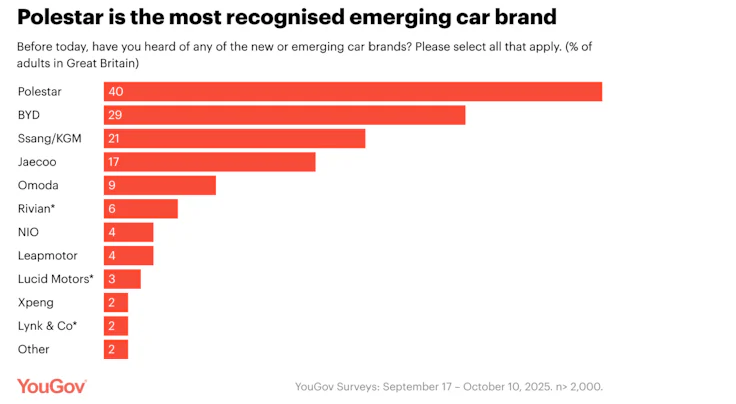
Visibility is critical, he said at an event to launch the data this morning (20 November). Feldman noted that people are discovering new marques through advertising on TV, as well as “seeing these brands on the road”.
Yet despite rising name recognition, familiarity lags behind. Even among emerging brands with strong awareness, a majority of consumers “don’t know anything” about the brands at all, highlighting a gap new entrants must close if they hope to drive conversion.
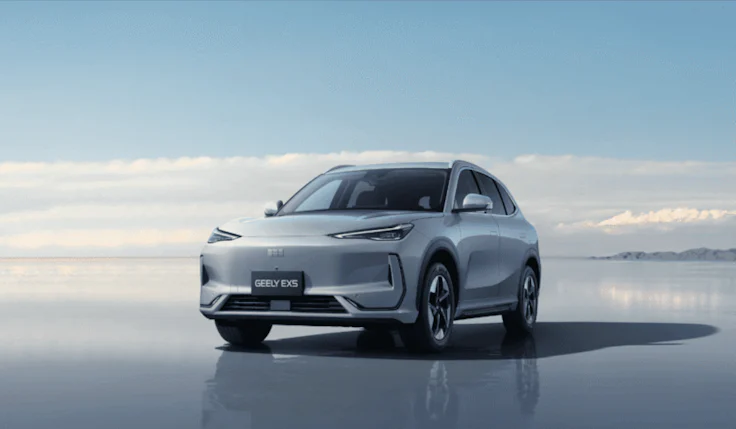
Similarly, Mark Blundell said on the launch of Chinese EV brand, Geely: “With the advent of new-energy vehicles, there’s a high propensity for people to try new brands, new vehicles,” he says. “The market is very receptive now to the overall proposition we’re able to offer.”
‘Nourish the brand’: How car marque Geely plans to drive long-term success in the UK
Eric Knight, head of media investment at Chery UK, said the acceleration in brand awareness of its brands, which include Jaecoo, Omoda and Chery itself, represents a “huge opportunity”.
“People are actually interested in what we have to offer again, and they’re all willing to buy, but we need to have actual confidence to match as well,” he said.
He pointed to strategies such as longer warranties and more comprehensive care packages, as a means to build trust in an unknown brand.
“What we know is that people here in the UK have the same basic insurance as anyone else, safety, credit, insurance – these are things that help build that additional trust,” he said.

However, according to the data, price is the strongest concern, cited by 46% of consumers in the YouGov study. Range, knowledge of the brand, peer recommendation and finance options complete the top five.
Notably, among people already aware of emerging brands, the decision set shifts: design, performance and sustainability increase in importance.
“It’s about unlocking those top factors,” YouGov’s Feldman explained. “Not everyone is going to tick everything… but these are the combinations that make the biggest impact.”
Despite rising momentum for newer entrants, brand reputation remains a powerful defensive moat for established manufacturers. Some 58% of drivers say reputation is important when choosing a car. Among those consumers planning to buy in the next 12 months, that number climbs to nearly 70%.
People considering an EV purchase also rank reputation as a high-value factor, though existing EV owners, who are naturally more likely to remain EV buyers, are less concerned with reputation.
With EVs now representing 5% of main cars in use, sustainability is moving from a niche motivator to a mainstream decision factor, at around a fifth of those surveyed (21%).
For BYD, social media use, especially TikTok, has allowed them to tap into a younger market. This generates impact when 18-34 are more likely (23% vs average of 12%) to purchase a car from an emerging car brand.
BYD on why TikTok is now a ‘permanent part’ of its always-on strategy
The barriers to consideration
The biggest barriers for challenger brands are all linked to trust. Drivers worry about cost and expense, the challenge of finding spare parts and reliability. Limited dealership coverage further compounds the perception gap.
Feldman warned traditional OEMs (original equipment manufacturers) cannot rely on heritage alone. “The market’s changed significantly… It’s far more competitive than it was,” he said. “They cannot rest on their laurels”.
Mat Thomas, senior manager for brand at Lexus UK said to that end that while an established brand in the UK like Lexus has high awareness, it does not necessarily come out on top of the market in terms of purchase consideration.
He added that you can’t build a brand by just talking to a few, “you need to talk to broader audiences”.
Not everyone is going to tick everything… but these are the combinations that make the biggest impact
Russel Feldman, YouGov
Thomas said the brand has shifted its media and sponsorship strategy to improve brand salience.
Lexus got “quite seduced by the whole concept of digital media”, he said adding that it used hyper-targeted influencers and brand ambassadors. “People said the brand needed to be in premium titles and in premium spaces. […] however my response has always been that you can trade a bit of class to go broad and build your brand,” he said.
In terms of combining mass reach with Lexus’s premium positioning, Thomas pointed to the brand’s decision to target a tennis audience.
According to the data gathered by the brand on tennis fans, the brand is now the top OEM associated with tennis, thanks to its association with Sky Sports Tennis and the Lawn Tennis Association alongside other sponsorship opportunities.
He said its research showed Lexus was the “most improved” brand in terms of purchase consideration since employing these strategies.
“You need to tap into the right brain, you need to show promotion and advertise,” he concluded.