Octopus Energy wanted to change the system, now it is the system
B2B tech platform Kraken transformed owner Octopus from challenger brand to software giant, but as they split and scale, will Octopus’s purpose survive?
 By John Miller
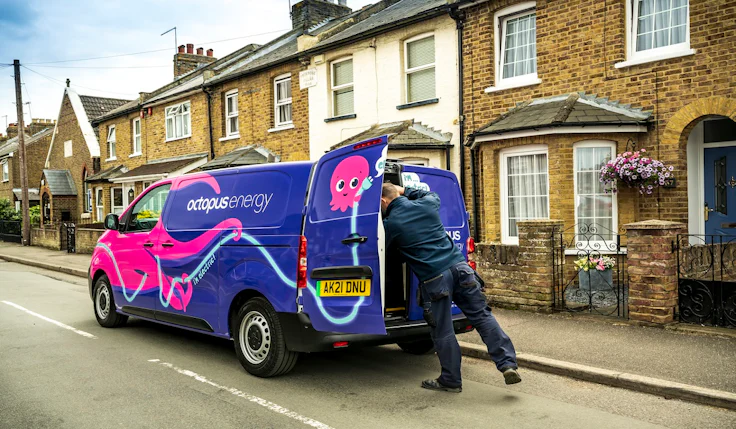 In less than a decade, Greg Jackson has built Britain’s largest energy company – 7.5 million UK customers, 10 million globally and an estimated $20bn in annualised revenue.
From the start, Octopus Energy behaved nothing like a utility. It wrote emails on first-name terms, cracked jokes in customer service chats and replaced jargon with emojis. In a category built on confusion, Octopus led with clarity.
But it wasn’t the only one to make energy empathetic. Its now-defunct rival Bulb also built a brand on transparency, simplicity and renewable resources. It moved fast, making its entire customer experience mobile-first, with digital onboarding so slick that switching suppliers only took minutes.
Its growth was powered by a viral referral scheme that turned customers into advocates, complete with ready-made templates for social sharing. With that mix of clarity, convenience and word of mouth, Bulb grew at extraordinary speed. By 2020, just five years after launching, it had 1.7 million households and £1.5bn in revenue.
Octopus wasn’t far behind. While it shared Bulb’s renewable energy mission, it leaned more heavily into human connection. Its digital marketing strategy became a case study in performance – and the power of the Google Ads suite. A YouTube for Action campaign lifted brand consideration by 3.5% and awareness by 5% – while view-to-conversion rates surged by 714%.
Octopus knew from the start it had to become the best at two things at once: trading and trust.
Still, the early years were tough. Between 2019 and 2021, Octopus Energy Group quadrupled in size – growing revenue from £477m to £2bn, and improving gross margins from 1% to 7%. Yet the group’s net losses widened from £33m to £65m.
That’s because the retail energy business is brutal. Profit margins for the ‘Big Six’ suppliers are in the single digits. And Octopus mostly doesn’t make its own product – it buys and resells the majority of its energy – so the only way to improve margins is to buy low and sell high, a dangerous game with such a volatile wholesale market.
Both Bulb and Octopus tried to compensate for that risk with brand. Big campaigns, clever copy and a promise of fairness – they made utilities look more like tech startups than suppliers. Bulb grew faster and marketed louder – but when wholesale energy prices spiked after the Ukraine war began, it collapsed almost overnight.
Octopus founder Jackson, however, had realised early on that with energy margins this thin, charm alone wouldn’t overcome economics.
Octopus knew from the start it had to become the best at two things at once: trading and trust. It needed to know precisely where it stood on every kilowatt and every customer – while maintaining the brand that made people choose it over others.
Octopus Energy’s CEO on why marketing should ‘define everything’
Tech infrastructure
So, in 2016, Octopus started building Kraken Technologies – an internal trading and customer management platform that would change the company’s trajectory for good. Because Jackson quickly realised this tool wasn’t just useful for Octopus – it could transform the entire energy market, so much so that Kraken has now spun off as a separate entity.
In late 2019, Good Energy became Kraken’s first external customer. By 2020, the platform had announced contracts to serve around 7 million households through E.ON and npower in the UK, and Hanwha and Origin Energy in Australia.
Octopus’s mission was to serve 100 million households by 2027 – and as of this year that goal is on track. By 2023, Kraken was powering 32 million customer accounts. Today, more than 71 million customers globally benefit from the platform through licensed utilities including Tokyo Gas, Eni Plenitude and Energy Queensland.
Kraken’s profitability now dwarfs the Octopus retail business. Licensing revenue rose from £67m to £81m between 2023 and 2024, while contracted recurring revenue reached £166m by year-end – up 81%. That implies around £130m of profits from Kraken if margins are near 80% (typical for software).
It’s the same playbook Amazon wrote with Amazon Web Services (AWS); retail built the brand, infrastructure built the value. AWS generates roughly 60% of Amazon’s operating income despite accounting for just 17% of its revenue. Kraken effectively did the same for Octopus – turning an energy company into a software platform that happened to sell energy.
Between 2021 and 2024, Octopus’s top-line group revenue grew from £2bn to £12.4bn, while profit swung from its largest net loss of £141m in 2022 to £83m net profit in 2024. As well as inheriting the customer books of collapsed rivals such as Bulb and Avro and separately that of Shell Energy Retail in 2023, Octopus invested heavily in visibility – marketing spend more than doubled to £88m in 2024. The brand is now no longer compared to British Gas but to Salesforce. A business that once fought for survival carried a $9bn valuation in 2024.
‘We could all be a lot braver’: Octopus Money on disrupting a ‘very tired market’
Challenger to leader
In 2025, Octopus overtook British Gas as the UK’s largest energy supplier – the first time the crown had changed hands since the 1990s. The challenger has become the establishment. The question is: can Octopus keep changing the system now it is the system?
As attention shifts to Kraken – new markets, new contracts, new investors – and Octopus takes on the mantle of market leader, the consumer brand that made people care about renewable energy risks dilution.
After Octopus announced the spin-off of Kraken in September, rumours of an IPO for the newly independent company began to circulate, yet the two businesses still share a founder and the same offices, and it’s reported that Octopus intends to keep a financial stake in the tech company. Over time, Octopus has evolved from a B2C brand to be as much a B2B infrastructure business – a transformation that will likely raise questions about its future purpose and priorities. And one that many big brands failed to manage.
According to founder Adam Neumann, WeWork’s mission was to “elevate the world’s consciousness”. It grew from under 30 sites in 2014 to over 850 five years later, as purpose gave way to rapid expansion, excessive spending and steep losses ($1.9bn in 2018).
Uber learned that lesson too. During its hypergrowth years, it prioritised profits over people by classifying drivers as independent contractors. The move saved an estimated $209m a year in California alone, but left drivers without health coverage, minimum wage protections or overtime pay.
The question is whether Octopus and Kraken can keep their soul while running the system they set out to change.
When growth becomes the goal, culture and purpose are often the first casualties.
Initially at least, Kraken’s spin-off is largely symbolic, and more importantly Kraken learned how to grow from Octopus – culturally as much as operationally. That’s its competitive edge. Cutting those ties might make for a cleaner IPO story, but in reality the two will remain deeply intertwined.
And that’s the real tension: the rebel brand that made people care about their utilities is now the architect of the infrastructure behind them. The question is whether Octopus and Kraken can keep their soul while running the system they set out to change.
The best founder-led businesses manage to find a balance. Gymshark kept Ben Francis as the voice of its community. Huel kept Julian Hearn focused on purpose and product. And James Dyson still spends most of his time in R&D.
So far, Greg Jackson has led from the front on climate, fairness and transparency. If the IPO goes ahead, we’ll find out whether Kraken becomes the force that propels this mission – or the monster that consumes it.