The ‘effectiveness crisis’ is really media becoming democratised
The falling share of ad spend on high- versus low-attention channels has the industry wailing, but it’s just the effect of more SMBs buying online advertising.

It feels like there’s a report, post or story about the decline of advertising effectiveness every day. But does this bear scrutiny?
It is over six years since Peter Field released his IPA paper ‘The Crisis in Creative Effectiveness’ and five since research pulled from the Advertising Research Community (ARC) database seemed to refute this. In that time, the business world has weathered a pandemic-driven downturn followed by a rebound, but we can’t escape the ongoing debate about whether marketing’s efforts are having less of an impact.
In the age of hot takes and context-free social media posts, it has never been easier to offer a point of view that at first glance seems straightforward but upon a little more scrutiny begins to fall apart. Understanding market dynamics and trends should be a key part of a marketer’s skillset, and in a world of outsourcing thinking to AI we need to apply critical thinking even more.
One such industry data point is currently doing the rounds. Newsworks has released research that aims to support news brands in representing the strength of serious journalism. This is a laudable aim. The fourth estate is a key pillar of modern democracy and historic funding from the advertising industry has supported the good work of journalists globally.
But the observation that has stimulated interest is that advertisers are moving money away from ‘high-attention’ media (TV, radio, cinema, magazines and news brands) to ‘low-attention’ (out-of-home, social and online – search and direct mail are excluded). The generalised conclusion is that this is a bad thing, illustrative of the effectiveness crisis, and this has been amplified by effectiveness thought leaders, trade bodies and businesses across the marketing industry.

The finding is based on IPA Databank case studies from the last 10 years, combined with broad-based attention data from Lumen’s LAMP tag. But delving further into industry data shows the trend around high- and low-attention channels does not suggest what everyone thinks – and if we take it at face value we aren’t paying enough attention to market dynamics, which is a dereliction of duty for marketers.
What are the actual figures?
To understand the wider context, first you need to look at overall ad spend. By aggregating quarterly UK data from Warc and the Advertising Association, you can view the actual reported figures and extrapolate from them. What is clear is there has been a significant growth over the past decade, with a near 150% increase in overall UK advertising spend (excluding DM and search, as the Newsworks study also does).
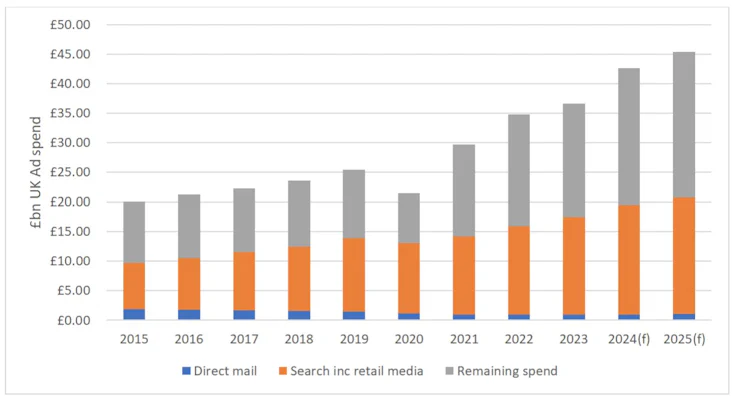
On its own it’s an interesting chart, showing the impact of Covid but also the rapid acceleration in ad spend recently. Adjusting for inflation also confirms the growth has largely been driven by incremental spend, but the question therefore remains, who is driving it?
The following analysis from Advertising Perceptions, a US research company – admittedly based on US businesses – reminds us of a specific trend that begins to answer that question.
Post-Covid, the ad spend cohort that has grown most in percentage terms is ‘Advertiser Direct’, in other words small- and medium-sized businesses (SMBs) buying media directly and not through agencies. This is happening in an expanding market and there is no reason to doubt the UK is witnessing a similar trend, or that the trend was present for a number of years preceding this.
To add to this, simple calculations show that the ‘big six’ agency groups have grown by around 16% combined since 2015, which is very different from the 150% change in advertising investment – they are growing at only around 10% the rate of market growth.
Changing rules of engagement: Is effectiveness shifting?
Crisis of effectiveness or new media buying demographics?
Therefore, what we appear to have is a different angle on the supposed ‘crisis of effectiveness’ driven by investment in lower-attention media. What if the shift away from high-attention media is a actually function of democratised media buying, and the cohort driving this aren’t the big advertisers but the small ones, which are often priced out of high-attention media opportunities. Look at most Meta and Google B2B marketing and it references SMBs explicitly.
In the UK there are around 5.7 million businesses according to the Office for National Statistics. Of these, small businesses with fewer than 50 employees make up 5.6 million. Of these, 4.3 million are non-employing businesses or partnerships, including sole traders.
It is entirely possible that the investments in low-attention media are being driven by small businesses that are buying direct and taking advantage of the rise of self-service ad platforms to help drive their businesses (which make up around 50% of the national economy). These are clearly the businesses Meta CEO Mark Zuckerberg is referencing when he says: “The fundamental aim here is for any business to approach us, articulate their goals… indicate how much they are willing to invest to reach those outcomes, link their bank account, and we will then deliver as many results as possible.”
He is referencing Meta’s core customer segment, the SMB.
The margins for success at a small business are fine. Every single pound spent has to deliver some sort of return to support cash flow. People’s livelihoods rest on it. As a result, there are a number of straightforward questions to ask:
- Is this investment in low-attention media working?
- Could SMBs benefit from utilising high-attention media?
- Can SMBs afford and access high-attention media?
The assumed answer to question one, due to the fine margins associated with small-business success, must be ‘yes’. We must acknowledge that effectiveness for a small business is very different from that required by a large business. So, if it is these SMBs that have been driving the growth in total advertising by investing their money in low-attention media (at a lower cost), then the suggestion that we are experiencing a crisis of effectiveness is no longer correct.
The same quote above from Zuckerberg can also be used to frame and answer questions two and three, alongside the recent announcement by ITV that it is entering the AI production game. Yes, SMBs could probably benefit from high-attention media and in the near future they can almost certainly afford access to it.
This new reading of the market suggests that there is no widespread advertising effectiveness crisis. Rather, the industry requires a more sophisticated understanding of market dynamics and businesses’ differing needs.
‘Your friend not your enemy’: Closing the marketing effectiveness skills gap
Let’s pay better attention and think a little more
Laying out these simple data-points paints a different picture from the usual view of advertising effectiveness decline. Over the last 10 years the barrier to entry for advertising as a growth lever has been lowered, and access to myriad platforms and tools has exploded. Much of this expansion is has come from low-attention media.
Those driving this trend are most likely smaller businesses that have benefited from accessing a larger market for their historically local products, or that have started using advertising for the first time. Effectiveness is relative here, where every pound must contribute to cash flow fairly quickly. There is little doubt that this sort of investment has been beneficial to SMBs and the wider economy.
The framing of the ‘crisis of effectiveness’ is reminiscent of those who claim “digital has never built a brand”, which can immediately be disproved. The data does not play into the simple industry narrative; instead, it points to the realities of running an SMB and taking advantage of the available tools.
An interesting corollary to this analysis is the potential for removing barriers to producing creative assets for high-attention media. By enabling the accessibility of creative production to catch up with that of media targeting, we are actually opening up the opportunity for a larger cohort to benefit from high-attention media choices.
Overall, this debate points to an increasingly important challenge, which we in the marketing community need to face as part of the AI revolution – one of critical thinking; of truly understanding and interrogating the underlying dynamics of the market. This is a fundamental part of marketing, and can help us avoid hyperbolic pronouncements based on data that doesn’t say what we think it does.
It also allows us to become more clear-eyed about what could happen in the future, and what that means for the industry.