You can’t dismiss AI ads as slop when they’re winning in testing
New research by System1 and Jellyfish shows AI-produced ads testing significantly better than the average traditionally made ad.
 By Tom Roach
 Ad testing company System1’s Andrew Tindall and I have just released some brand new research into AI-assisted video ads.
We wanted to understand where the industry is at right now with the quality of AI brand ads being made, how AI-assisted ads tend to score in testing versus traditionally produced work, and how audiences respond to it.
So we put out a call to marketing and advertising people to share AI ads they’d seen, to gather as wide a selection as possible.
This is what I predicted in the LinkedIn post asking for examples: “What are we going to learn? There’ll be some surprises about how well some of these ads will do. People probably won’t notice or care how we make our ads – that’s our business. They just care how they make them feel.”
This doesn’t exactly make me a modern-day Nostradamus, but all of this turned out to be correct. What I didn’t have the guts to predict was that the AI ads would test better than traditionally produced ads. ‘AI ads are just slop’ is the opposite of what we found.
It’s new and groundbreaking research, but it’s of course only a small study given we’re still only in the foothills of mainstream AI brand creativity. But whilst the sample of 18 ads we gathered is small and biased towards ads that have already caught the industry’s attention, it feels representative of the ‘state of the nation’ in AI brand creative today.
‘AI ads are just slop’ is the opposite of what we found.
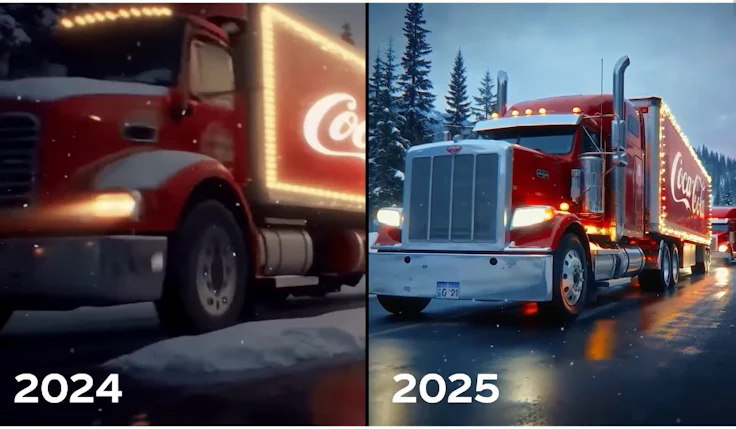
The 18 AI ads are an eclectic bunch. Some have been much-discussed and even slated by the industry (Coke’s 2024 and 2025 ‘Holidays are Coming’ films), some are unknown, some are ‘spec’ ads that have gone viral amongst marketers (Ikea’s ‘Exploding box’ and Liquid Death’s ‘Arrestingly Refreshing’). It was mostly US and UK work, and was from a range of categories: automotive, soft drinks, water, smartphones, news brands, kitchen appliances, ready meals and travel booking apps, amongst others.
The ads were made by a mix of agencies, AI production companies and solo AI creators. Full disclosure: seven of the 18, so just over a third, were by Jellyfish and other Brandtech Group companies (Gravity Road and Oliver). So the selection is naturally unusual – and that’s no surprise because, while the future of AI creativity may already be here, it’s not yet evenly distributed.
System1 tested the ads with humans, and in line with my recent piece on ‘Winning hearts, minds and models’, we also tested them on Jellyfish’s Share of Model platform to understand how LLMs might interpret and respond to them.
We presented our initial findings at Jellyfish’s offices in the Shard last week. The event also included a presentation by Jellyfish’s creative teams of AI-assisted work made to a fun brief chosen by an audience of clients. The brief was chosen at 10am and a full AI-produced campaign was presented six hours later – a live demo of what we call ‘real-time creativity’.
‘Eroding trust’: Marketers debate the role for ‘AI-enhanced’ creative
AI-assisted ads performed better
The results of our study showed the AI ads got an average star rating of 3.4 from System1, versus an average of 2.3 in its total database of 123,000 video ads.
 So the evidence we have says AI ads can ‘work’ better than standard ads. AI ads are being made by experts – we’re not talking teenagers in bedrooms making memes here. These are ad creatives and video makers who are seizing the opportunities offered to them by this new technology. These ads have been made by smart people, pushing this new and advancing technology to the limits of what’s currently possible – ad experts putting the new tech into the service of brands, and clients with strict standards and commercial objectives.
These ads are managing to outperform the average standard of the 123,000 others in System1’s database. And they’re doing it faster and more efficiently than before. This is not low quality content.
This is refreshing and even exciting to learn – it can help us start to debunk some of the myths and clichés that have started to stick around AI generated ads, amateurism, carelessness, and a lack of craft and critical thinking, which some people have lazily assumed AI creativity is all about.
It can also help us start to overturn the global narrative, which extends way beyond the marketing industry, that the benefits of AI are purely around efficiency and savings. Yes, those are benefits. But System1’s data is predictive of brand growth. Effectiveness, not efficiency. Could the marketing industry, already a big adopter of AI in comparison to other industries, be one of the first to see some of the future growth benefits of AI? This study is too small to be real evidence of that, but it plants that seed.
And though the sample was small, there’s some evidence that UK-produced ads are driving much of the outperformance in the study overall – UK AI ads averaged a score of 4.6 versus a UK total average of 2.6. Could this be an early sign of the potential for AI to help the important but beleaguered UK creative industries drive growth and competitive advantage globally?
Tom Roach: Creative people will be at the heart of marketing’s AI revolution
If not prompted, people couldn’t tell the difference
 We didn’t want to trigger any respondents’ biases about AI, but when asked about production style, around a third (32%) of respondents thought the ads looked like a ‘typical professionally produced ad’. Another third (33%) had an even more positive view that the ads ‘had a distinctive or unusual style that stood out’.
Coke’s 2025 ‘Holidays are coming’ film is as loved, if not even more loved, in its latest AI incarnation, as in any of its previous CGI versions. It scored System1’s maximum 5.9 stars, with. 71% of the total emotional response it evokes being ‘happiness’, versus a category average of 36%.
 Whilst LinkedIn AI sceptics are busy counting Coke truck wheels for consistency, consumers are excited that this film is back on, as it is consistently year after year, making them excited for the arrival of Christmas and associating that feeling with Coke.
Coke truck tyre counters: 0, Coke’s cutting edge AI creatives: 1.
‘No substitute for truth-led ideas’: What AI means for marketing creativity
Ads recognised as AI tested better on average
It’s common to hear people say that AI ads can’t evoke emotion, claiming that they’re not authentic enough or that the ‘uncanny valley’ kicks in and gets in the way. Well, this research shows that’s wrong, given System1’s star rating is fundamentally built on an emotional response.
One of the most surprising findings was that ads that were strongly recognised for using AI didn’t suffer in emotional response, and in fact AI production techniques may have helped create more emotional impact – the top 50% of AI ads that were recognised as AI had a star rating of 3.3, versus the bottom 50% with an average of 2.3.

Again small sample, and it’s really unclear why this might be.
But here’s a theory that seems to fit the AI work we tested: AI allows brands to create far bigger, more spectacular ads than would be possible from traditional production methods on the budgets they have. And people love a spectacle: it can evoke happiness, even awe – one of the most powerfully intense emotions of all.
For one brand in the mix, a luxury travel brand, we were able to create, on a spectacularly small budget, a spectacular film featuring cinematic quality footage of the destinations and experiences on offer.
This ad got a star rating of 3.1, and was especially strong on ‘surprise’ (43% versus the US average of 15%), one of the most powerful emotions you can evoke. One respondent said: “Amazing ad. How inspiring! Never seen anything like it.”
So AI enables access to production values that were previously only available to a tiny handful of big brands, and never before to small and medium-sized brands.
There’s been a lot of talk about AI helping us make impossible ads possible, and this feels right. But maybe the barrier to overcome in making impossible ads wasn’t so much the limitations of our imaginations, but the limitations of our budgets.
So how did these ads do when tested on our new audience, the LLMs?
We tested all 18 ads in Jellyfish’s Share of Model platform and the ads all scored between seven and nine out of 10. We see that LLM scores tend to be a little more generous than System1 scores, but brand by brand they follow a similar pattern to System1 testing. The top, middle and bottom ads in System1 and Share of Model were the same.
The correlation between the humans and the LLM scores was 0.56 – human audiences and LLM audiences respond to ads in ways that have some kind of relationship, but it’s not a perfect one.
 We also tested the ads with our Pencil ad improver agent. Here’s the unbiased, helpful and actionable direction it suggested for one ad:
- Attention (5/10): Not disruptive enough to stop a busy parent from scrolling
- Branding (3/10): A busy viewer who scrolls away before the ends will miss the brand
- Clarity (4/10): The message is unclear for the majority of the ad’s duration
- Emotion (4/10): Abstract scenario may not resonate as much as a real-life one
- CTA (2/10): No clear next step, leaves the viewer with no path to purchase
So not the uncritical, overly positive voice the LLMs are often said to be.
New research is needed into the drivers of creative effectiveness with this new audience, the LLMs, and that’s our next step on this. We’re planning a big new research study with INSEAD and System1 looking at defining the drivers of creative effectiveness for the models, and for dual-targeted (human and LLM) creative – building, of course, on the known drivers of creative effectiveness with human audiences: attention, branding, emotion, and the known drivers of long- and short-term sales.
Future communications strategies are going to need to understand these drivers to understand how to make creative work attuned to a range of audiences and objectives: what works for humans, LLMs or both, both in the long and the short term.
We’re only a couple of years into this revolution and AI-assisted ads can already beat traditionally-produced ads. But there’s no sign at all yet that the models are anywhere near close to doing this without their imaginative, emotional, subjective human operators.
The human/genAI creative duo is currently where it’s at – and all the signs are that it’s going to be an incredible partnership.