Heineken CEO: Marketing is about growing consumer penetration
The beer giant is rolling out a new brand building model and putting weight behind its AI-powered virtual marketing agency to drive growth.

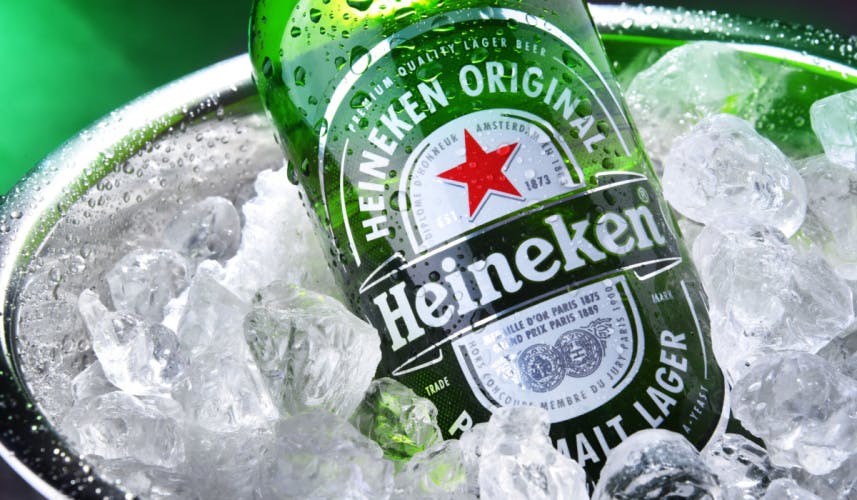

Heineken is upweighting its marketing spend, tapping into “pockets” of opportunity and adapting to a new brand building model in a bid to fuel growth.
The opportunity presented by non-alcoholic or 0.0 beers was a particular topic of conversation during the company’s 2025 full-year results call today (11 February).
While the business owns an array of beer and cider brands, including Birra Moretti, Strongbow and Cruzcampo, Heineken was a particular focus of discussion.
The brand is introducing a line extension Heineken 0.0 Ultimate, in addition to its existing Heineken 0.0 product. This non-alcoholic beer also contains zero calories and sugar, as well as no alcohol. During the call with investors, CEO Dolf van den Brink was asked whether the line extension risked taking share from Heineken’s existing non-alcoholic beers.
‘Stretching into new occasions’: How Lucky Saint is using innovation to pursue category growth
The innovation is designed to cater to different occasions (or using an alternative term, category entry points), Van den Brink said, with the original 0.0 designed to cater to occasions where people might have drank beer, but want a non-alcoholic alternative.
Heineken 0.0 Ultimate, on the other hand, is designed to reach into new occasions such as around sport. The Heineken 0.0 brand recently became the global beer partner of Premier Padel, a professional tour for the fast-growing racket sport. Van den Brink said this partnership was designed to drive association with new occasions, thus getting the drink into the hands of more consumers.
“At the end of the day, marketing is about growing consumer penetration,” he said. “And that’s what we’re trying to do very intentionally with these line extensions.”
Expanding on the topic of non-alcoholic beers, Van den Brink claimed that, as a leader in the space, Heineken was helping drive the category into new occasions.
“Where the first generation of 0.0 beer started very close to beer occasions […] we do believe, indeed, that we can start to go to new occasions that were not accessible before,” he said.
While Heineken is looking to drive penetration of its brands, it was a difficult year for the beer category overall. Heineken did deliver increased revenue in 2025, with sales up 1.6% in the year. However, volumes dipped by 1.2%, suggesting the business failed to drive increased demand globally.
An evolving marketing function
As well as expanding into new occasions, the CEO outlined opportunity for the business to make more of what it has already got, particularly through AI.
In its marketing function, Heineken is utilising a tool called FreddyAI, which the company describes as an “AI-powered virtual marketing agency”. By the end of 2026, the beer giant expects close to 80% of its marketing and selling investment to be “onboarded” into the tool.
According to Heineken, the tool is designed to drive faster execution at scale and allow its brands to get closer to consumers.
In 2025, the company increased its marketing investment to 9.9% of net revenue, up six basis points versus the year prior. That pattern of increasing investment in marketing is set to continue in 2026. However, while Heineken expects its AI tool to enable it to spend less on ongoing marketing activities, it did not confirm whether this would mean a reduction in absolute spend, or a reinvestment.
“[FreddyAI] should unlock significant savings,” Van der Brink said. “To what extent we will reinvest these savings, or whether we will let them go to the bottom line is to be determined along the way.”
Best practice unveiled for responsible use of AI in advertising
In addition to the impact of AI, Heineken is also adopting a new brand model designed to “support consistent execution and better value delivery”. This basically acts to centralise the brand building work of the firm’s global brands, said Van der Brink, giving the example of how Heineken currently functions.
“Positioning, campaigns, taglines, commercials are all centrally developed and sometimes adopted or customised for differences across regions,” he said.
However, on some other global brands the brand work is done in other locations, such as Birra Moretti where the work is done in Italy.
“The team in Italy doesn’t have the kind of global perspective that is now needed going forward and the same applies to the other global brands,” Van der Brink said. “So this is really about a strong global brand team centred in Amsterdam, with a global perspective, and really taking ownership.”