Gucci owner plans to up brand investment to ‘reignite desirability’
Kering’s CEO admits the luxury business had cut above-the-line investment but would now be upping focus on activity that “speaks to consumers”.
Luxury fashion business Kering, owner of brands including Gucci, Saint Laurent and Alexander McQueen, plans to overhaul its marketing strategy, putting greater focus on above-the-line activity that “speaks to consumers”, after posting disappointing results for the year.
Kering CEO Luca de Meo admitted the business had been underinvesting in upper-funnel brand work that builds relevance and long-term equity, instead focusing on more tactical, performance-led activity.
He said the business needed to “reignite desirability… house by house, product by product, client by client”.
“What I could see as a problem, but also, therefore, as an opportunity, is that we have been protecting below-the-line… marketing investment,” he said on a call with investors this morning (10 February).
“We have been cutting above-the-line, which is the one that brings traffic to the stores… you will see a little bit more accent and investment on the above-the-line, which is the thing that speaks to consumers.”
As part of this, he said Kering plans to “renegotiate some of the contracts” it has with its media agency.
Kering’s revenue dropped 13% to €14.68bn (£12.76bn) in 2025, with its operating profit down 19% to €3.68bn (£3.2bn).
While Q4 showed signs of stabilisation, executives were clear that renewing brand desirability – not just tighter cost controls – would be key to financial recovery.
CFO Armelle Poulou said: “We will invest some money in marketing, and I’m not talking only about advertising”, adding that it will invest in “all the different directions to recreate that desirability and to drive the traffic”.
The reset comes as luxury brands face slower demand, with brands across the sector struggling to perform.
LVMH talks up ‘strong desirability’ despite sales slip
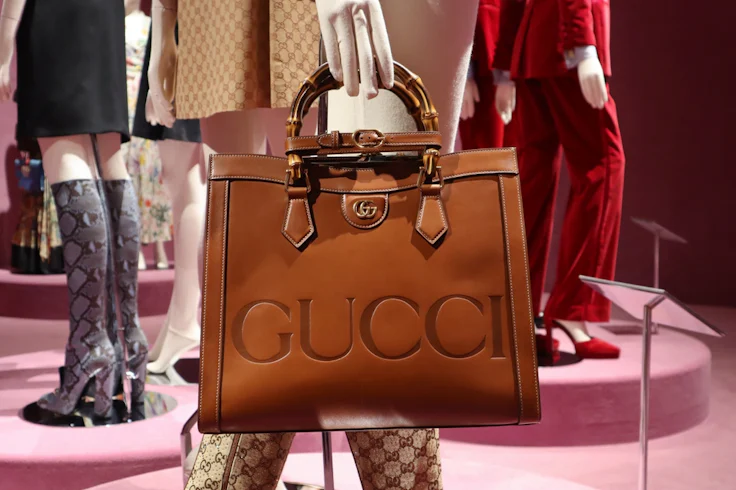
By division, Gucci continued to weigh on group performance, with full-year revenue down 13% on a comparable basis, though Kering pointed to sequential improvement in the second half and early signs that renewed creative direction and marketing activations are beginning to land.
The group said recent creative changes and “surrounding activations” have helped put Gucci “back at the centre of attention”, with further investment planned to amplify reach and consistency across markets.
By contrast, Bottega Veneta delivered one of the strongest performances in the portfolio, with comparable sales up 9% for the year, supported by sustained demand for leather goods and a tightly controlled brand strategy.
At Balenciaga, sales declined mid-single digits, reflecting both market conditions and a period of transition for the brand. Management said the focus remains on long-term positioning rather than short-term volume recovery.
Other houses, including jewellery brands such as Boucheron and Pomellato, posted solid growth, with Kering pointing to jewellery as a category where clearer brand narratives and category-specific marketing can continue to unlock value.
Burberry enjoys ‘increased confidence’ as sales grow
Regionally, performance remained uneven. Asia-Pacific revenues declined 8% on a comparable basis, with China still subdued despite some improvement in domestic demand toward the end of the year.
Western Europe was broadly stable, supported by tourism flows, while North America fell 5%, reflecting a more cautious consumer environment at the high end of the market.