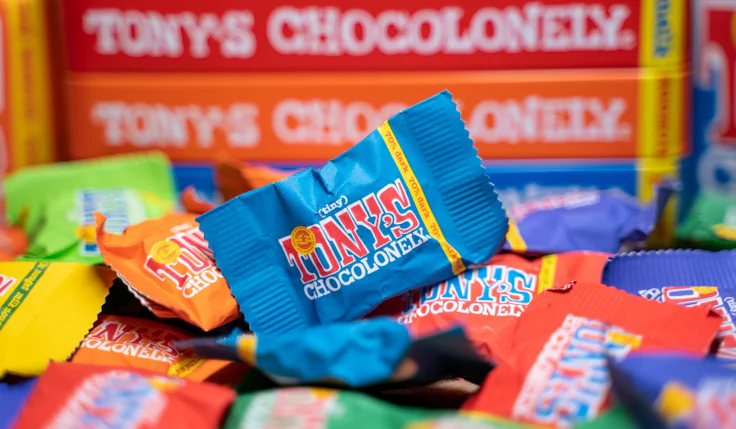
‘Pour fuel on the fire’: Tony’s Chocolonely on using its TV debut to accelerate growth
The brand achieved its best-ever market share in the last four weeks of 2025, and grew revenue by double-digits in the year. It is now looking to build even further.

 Tony’s Chocolonely is launching a TV campaign for the first time, as it builds on its best-ever share figures to win against the giants in the chocolate category.
The ethical brand only began investing in paid media a few years ago, having previously leant on earned and organic to drive growth. Now, it is making its debut on TV, something the brand sees as a chance to “pour fuel on the fire” of its growth trajectory.
Now is the “best possible time” for Tony’s to make its TV debut, UK and Ireland head of marketing Nicola Matthews tells Marketing Week. In July, the brand was awarded £500,000 in TV media spend through the Sky Zero Footprint Fund, the broadcaster’s sustainability ad fund.
“We just thought [TV] was something that was out of our reach because of the budgets that we had,” Matthews says.
It’s still always been very much like, idea first, then media spend, because we’ll never be able to outspend a bad idea.
Nicola Matthews, Tony’s Chocolonely
Budgets had been a driver in the brand’s decision to focus on earned media until relatively recently, with an understanding that it could not outspend the chocolate giants on media. It was also founded with a belief that “if you have a story worth telling, you shouldn’t have to pay to tell it”.
The brand’s mission is to eradicate slavery and exploitation throughout the chocolate supply chain, a message it aimed to spread in the early years through PR. It also did a lot of sampling work and partnerships to get Tony’s bars into hands.
Why Tony’s Chocolonely is now investing in paid media
Tony’s Chocolonely grew with the belief “when you can’t cut through with cash, you can cut through with creative thinking”, says Matthews, adding that this was something it very much embedded as it started investing in paid media a few years ago.
She describes the brand’s approach to paid media as “very strategic and targeted”.
“It’s still always been very much like, idea first, then media spend, because we’ll never be able to outspend a bad idea,” she says.
She gives the example of a campaign based around the fact many consumers mispronounced Tony’s Chocolonely as “chocoloney”. Pointing this out to consumers provided a “real a-ha moment”, Matthews says, adding that the brand used paid media to accelerate that piece of creativity even further.
Nailing down brand goals
The deliberate and measured approach taken by Tony’s Chocolonely to its paid media has allowed it to learn along the way. One key lesson highlighted by Matthews is how it works with influencers.
Its creator strategy has been to focus on working with people who are already fans of the brand, what it terms its “serious friends”, rather than prioritising working with influencers based on reach.
It did try working with an agency to collaborate with creators who weren’t already fans of the brand, but Matthews says “it’s just never been as powerful”.
The lessons it has learnt have enabled Tony’s to become more confident in how it invests media spend; however, it still operates on relatively small budgets, meaning it really has to ensure every pound is working. That process includes being crystal clear on its objectives as a brand.
Being really clear on those brand objectives has helped us point and shoot our paid media in the right places, rather than spray and pray.
Nicola Matthews, Tony’s Chocolonely
Tony’s Chocolonely worked with Ipsos to do some in-depth brand tracking a couple of years back, Matthews notes. What was uncovered from that process was that, because Tony’s is an ethical chocolate brand, there was a perception it might not taste as good as competitors.
“People think ethical chocolate can’t taste amazing,” Matthews says.
That insight has informed a focus on taste in its communications strategy across all its channels, with the brand using paid media to amplify messages around the tastiness of its product.
“Being really clear on those brand objectives has helped us point and shoot our paid media in the right places, rather than spray and pray,” says Matthews.
Chocolate as a luxury worth paying for
Tony’s Chocolonely has seen impressive growth in recent times. In the UK and Ireland, it increased sales by 14% year on year in the 12 months ended 30 September, with revenues reaching €51.2m (£44.4m).
It also drove impressive share gains in the competitive chocolate category. In the last four weeks of 2025, which covers the critical festive period, Tony’s hit 4.9% share of the block chocolate category. Some 1.7 million bars were sold by the brand in those four weeks alone. This was a record market share for the brand in the UK.
While there’s no one factor that drove that result for Tony’s Chocolonely, Matthews says the brand’s premium position helped it stand out.
“There’s no shrinkflation, it’s as chunky as ever, it’s premium, the packaging looks amazing. It’s weighty, it’s special, it’s really giftable,” she says. “We don’t actually have to package that up into festive specific packaging. People just love to gift the bar as it comes.”
Disrupting ‘zombie-like behaviour’: How brands can stand out in commodified categories
2025 was a year when the chocolate market was particularly challenged, with cocoa prices skyrocketing because of record low yields. Many brands have reduced the amount of cocoa in their bars, engaged in shrinkflation, and put up prices.
While Tony’s Chocolonely has had to increase prices in line with the price of cocoa increasing, shrinkflation or reducing the amount of cocoa in its bar is something that’s off the table for the brand, says Matthews.
“We’re trying to help people understand the chocolate should be premium,” she says. “It should be a luxury good when you know you’re not paying enough for the product at the start in the supply chain, somebody is always suffering.”
That refusal to engage in the commodification of chocolate stands Tony’s Chocolonely in good stead for being seen as a premium treat by consumers, and helps people to appreciate the value in the product.
It really felt like someone had just handed us rocket fuel.
Nicola Matthews, Tony’s Chocolonely
While Tony’s values its premium positioning, the brand also appreciates the need to bring people into the brand by having products at different price points. Its 180g chunky block bar remains the hero product, but it has now also introduced a smaller 90g bar in the same style.
That product is designed for those new to the brand, who want to try Tony’s, but perhaps can’t justify buying a larger bar just yet. The new size was launched in August and has already contributed an extra 1.3 points of incremental penetration, says Matthews.
“That’s not the sexiest innovation, because it’s format, price point, rather than new news, but it’s really doing an incredible job of making us more accessible to more people, which is how we’re going to scale,” she says.
Set up for success
From its work on its paid media to securing distribution in Sainsbury’s, Tony’s Chocolonely is in a very good position to continue growing, she notes, meaning the TV campaign has come at a perfect time.
“We’ve got great physical distribution and great understanding of the brand, and a lot of the earned and owned stuff, the mental availability stuff that we’ve been doing is really working,” she says. “It really felt like, ‘Oh, if we could just pour fuel on the fire with TV, we could scale even faster’.”
The process of securing the £500,000 as part of Sky Zero Footprint Fund involved pitching an idea up front, with the brand working closely with agency House of Oddities throughout the process.
The ad, ‘There’s Fight in Every Bite’, features professional wrestlers and is designed to bring to life on screen Tony’s fight against exploitation in the cocoa industry.
Tony’s Chocolonely’s messaging is not about fighting others in the industry, but about fighting exploitation in the cocoa supply chain, something that can be complex to convey, notes Matthews. However, she feels that the TV ad has distilled that down perfectly for screen, with the team having worked hard to develop the idea, and pre-testing it with System1.
“It really felt like someone had just handed us rocket fuel,” Matthews says of the moment she found out they had won money to go on TV.
TV advertising at 70: Behind the top ads in history
However, the brand did not want its TV ad to sit apart from the rest of its communications and has pivoted its activity to sit around the new platform, with Fight in Every Bite being the central component of the work.
From tomorrow (10 February), the brand will be kicking off a 360-degree campaign, encompassing PR, social media and experiential, bringing the wrestlers into the real world.
The brand will be closely tracking how its brand health metrics fare following the TV-led campaign, with Matthews keen to put together an investment case to invest in the media again in the future.
Punching above its weight
As the brand began investing more in paid media, it has faced the oncoming storm of less healthy food (LHF) advertising restrictions. These new rules, affecting foods high in fat, sugar and salt (HFSS), ban products in the restricted category from being shown in online advertising and on TV pre-watershed.
While the industry had been voluntarily complying with these rules from October, the law came into force from the beginning of this year. The rules have significant implications for creator marketing, as well as paid social and online display work.
As a confectionary brand, Tony’s Chocolonely falls under the restrictions, the aim of which is to prevent LHF products from being marketed to children. That’s a goal that Tony’s is very much in support of, notes Matthews, having never targeted children.
We’re great at punching above our weight.
Nicola Matthews, Tony’s Chocolonely
However, the regulations have meant it has had to rethink some of its approach, particularly when it comes to how it works with creators and with paid social.
“There’s stuff we’ve got quite good at that we can’t do anymore because of HFSS,” Matthews says.
While it can be frustrating that some of what Tony’s tested and learned from can no longer be applied now the new rules are in place, the brand has something of an advantage versus competitors when it comes to being creative with restrictions in play, says Matthews.
“I think we’ve got an advantage because we’ve never had the same paid budget as our competitors,” she says. “We’re great at punching above our weight.”