You don’t need a bespoke luxury-style branding strategy to succeed as a luxury brand
Luxury marketing doesn’t need to create its own ‘laws of growth’ for brands to succeed; there are some law-like patterns that luxury categories share with others and understanding them will make luxury brand marketing stronger.

I am not a fan of extreme sports. I once tandem skydived and all I got out of it was a video of me looking like an upset pufferfish (I breathed in at the wrong time).
But I am a fan of extreme research, where we take what we know and test it in unusual and unexpected waters. I am also a fan of fashion and shopping, which made it irresistible to test some fundamental patterns in buyer behaviour and brand perceptions in a Luxury brand context, because of the long standing belief that “luxury is different”.
What comes to mind when you think of luxury? Brands like Chanel, Louis Vuitton, Gucci and Balenciaga, with their iconic designs, gorgeous retail outlets, and often eye-watering prices. Think about the last luxury product you bought… it’s a world apart from your last toothpaste purchase. Or is it?
Examining how brands are bought and how buyers think about brands forms the foundations of effective marketing and because of their regularity – can be thought of as ‘empirical laws’.
But these empirical laws do not hold all the time, everywhere – even gravity is weaker on a mountain top.
With a limited customer base (not everyone can afford $5,000 for a handbag) it’s easy to assume loyalty is essential to growth, and that offering something different/unique/exclusive is needed to achieve that loyalty.
A challenge for the sector, particularly for small brands, is the difficulty in getting luxury brand data. Indeed many academic papers on the topic are conducted with university or M-turk samples due to the cost of getting real luxury buyers for research.
We are fortunate to have invested in some data on luxury buying and perceptions of luxury brands, collected from luxury buyers. Does luxury marketing need to create its own ‘laws of growth’ for brands to succeed? Let’s look at some empirical laws and see how luxury categories perform.
Leaning on meaning could undermine your distinctive assets
Double jeopardy
First we have the double jeopardy (DJ) law, which tells us the ‘niche’ small brand with the highly loyal customer base is like a Tasmanian Tiger – there are occasional sighting reports, but these usually turn out to be false. The DJ law shows us brands grow by acquiring more buyers in any timeframe. In the exclusive, expensive, craft-driven world of luxury, does DJ still hold?
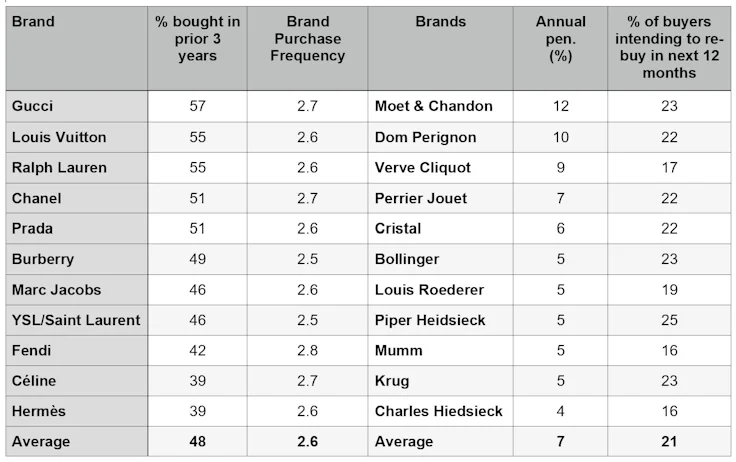
Our two categories (see table 1) leather goods and champagne both follow the DJ law. In leather goods, brands vary more in penetration (39% to 57%) than in loyalty (BPF: 2.5 to 2.8). Champagne brands differ threefold in penetration, while re-buy intent is around 20% for all brands. This suggests that if you want to grow leather goods or champagne brands, you need to get more buyers.
Natural monopoly law
Next is the under-appreciated natural monopoly law. Often people think it applies to big brands only. Indeed if your brand is big, then many buyers will buy you, particularly light category buyers who know few brands, and your big brand is likely one of the few – which leads to big brands monopolising light category buyers.
However the twist in the tale of the natural monopoly law is its implications for small brands, and this its particularly relevant for luxury, with many, many small brands who might be tempted to just focus on building a small loyal customer base. Yes DJ tells us this is unusual, but the natural monopoly law explains why.
Small brand customer bases skew to heavy category buyers, as shown for jewellery in table 2. Owners of jewellery from Fred, as a small brand, own on average 19 other jewellery brands, while owners of jewellery from Tiffany, own less than one third of the competitors.
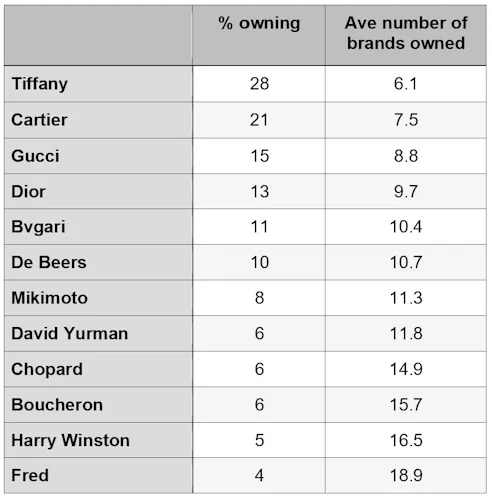
Therefore small brands compete with many more brands for mental and physical availability, even among their own buyers. Given ownership makes you more likely to notice marketing activity, and bigger brands typically have bigger budgets, this helps explain the challenges small brands face to grow, and why growing with a loyalty focus is something of a fool’s errand. Without the data to see this, it is easy to believe anything is possible if you are a small luxury brand.
How do luxury buyers perceive luxury brands?
Let’s now peek into the brand memories of luxury buyers and see what is stored in there. Much has been written about the qualities essential for a brand to be considered luxury – such as uniqueness, exclusivity, superiority, or heritage. Also a prevailing idea is that non-buyers’ desirability makes a luxury brand more appealing to those who can buy it (the ‘rarity’ principle) – the idea you have something that others covet.
This is at odds with normal patterns in brand associations, where brand users are much more likely to link a brand to an attribute than non-users. Indeed this pattern is so strong it can be used as part of an equation to predict how brands will score on most attributes.
Dr Ava Huang and I found luxury brand associations are also largely predictable. Buyers of a luxury brand are more likely to link that luxury brand with any luxury attribute (e.g. superior quality/craftmanship or unique from mainstream brands). Using the model from Romaniuk & Sharp (2000), we could estimate 90% of luxury brand-luxury attribute scores with +/- 2pp for three luxury categories in the USA and China.
Functional/descriptive attributes (e.g. has an equestrian history), or successful advertising messaging efforts are less predictable, but the advantage of benchmarks is the extent of the difference can be quantified. These norms are particularly powerful for detecting advertising effects over time.
Evidence-based marketing
Even luxury brands can have the luxury of evidence-based marketing to guide marketing strategy, key performance metrics and tactical efforts.
If you are a luxury brand marketer this is good news, you don’t need a bespoke, exclusive, luxury-style branding strategy to succeed as a luxury brand.
You compete in a market with other luxury brands, for largely the same type of luxury buyers. This means defining the category buyer and using that as your target market, having a product range that covers many popular luxury category entry points and being able to be easily bought by those with the means to do so, to take advantage of the desire you build.
To be clear, I am not saying people buy luxury products the same way they buy toothpaste or toilet paper. I am saying there are some law-like patterns that luxury categories share with non-luxury categories, likely by virtue of it being the same person with the same brain making both luxury and non-luxury choices.
Understanding and using those similarities makes luxury brand marketing stronger, not weaker.
Professor Jenni Romaniuk is associate director (international) at the Ehrenberg-Bass Institute of Marketing Science, the world’s largest centre for research into marketing.