Brands can connect their distinctive brand assets with meaning
While distinctiveness must be a priority for brand codes, these codes can also carry meaning to bring brands to mind in particular situations.

It’s becoming more widely accepted among marketers that brands need distinctive ‘cues’ or ‘codes’ – and that consistent use of these assets is key to building brand memory efficiently.
Brand codes such as logos, slogans and mascots make brands easier to identify, and recall. These distinctive brand assets – otherwise referred to as ‘me codes’ – are the cornerstone of mental availability. But is this the whole story? Can brand codes also help connect brands with meanings?
A recent Marketing Week column by Ehrenberg-Bass’s Jenni Romaniuk cautioned that prioritising meaning over distinctiveness can lead to brand assets that are generic, or even restrictive if the brand later expands into new areas. Her argument got us thinking: does the role of brand codes have to be limited to brand recognition and familiarity?
I’m a brand strategist and Jiri is the CEO of Behavio, an insights agency specialising in brand code development. We share a passion for understanding how brand codes can drive cost-effective brand growth. We agree with Romaniuk’s point – brands should invest in assets that are highly distinctive. However, we also believe brands must build mental links to needs, desires and occasions – what Romaniuk refers to as category entry points (CEPs). The best way to do this, surely, is through an additional type of brand code: what we call ‘need codes’.
You want your me codes to last decades, centuries even, especially given how much you’ll be investing in them.
Like me codes, need codes are distinctive and strongly associated with the brand. But while me codes are designed to identify the brand indefinitely, need codes exist to connect the brand to a specific need – and are only used for as long as that need remains strategically relevant.
- Me codes – timeless cues that uniquely identify the brand (e.g. McDonald’s arches).
- Need codes – tactical cues that link the brand with a specific need, desire, or occasion (e.g. the Happy Meal connects McDonald’s with kids; the Pumpkin Spice Latte makes people think of Starbucks in autumn).
We believe businesses should develop me codes that stand for the brand itself – free from restrictive meanings – while also investing in need codes to connect the brand with concrete category entry points in a distinctive and memorable way.
Me codes
When choosing distinctive brand assets, or me codes, the priority should be making the brand stand out.
These codes may also have some intrinsic meaning. Nike’s swoosh, for example, might suggest success, while a prancing jaguar might imply speed and grace. However, these meanings may not remain relevant as the brand moves into new areas. Therefore, it is important to avoid choosing an asset whose meaning could become a handicap if and when the brand wants to expand.
For example, Notino, now Europe’s leading online beauty ecommerce player, had to rebrand from Parfums because the name’s meaning became too limiting.
Leaning on meaning could undermine your distinctive assets
You want your me codes to last decades, centuries even, especially given how much you’ll be investing in them.
Back in 1915, a century before Sharp and Romaniuk described distinctive brand assets, Coca-Cola briefed its designers with this line:
“A bottle so distinct that it could be recognised by touch in the dark or lying broken on the ground.”
No mention of meaning. No benefits. No occasions. Just distinctiveness. Hence, best practice for me codes. Focus on about three meaning-free codes that cover multiple memory types (semantic, visual, audio) and stick with them forever.
Need codes
If me codes are focused squarely on representing the brand’s identity and no more, how can brands build memory structures that help them come to mind in buying contexts?
This is where the idea of need codes comes in. Need codes are creative elements or themes that become connected with a brand through repeated use. Unlike me codes, need codes are designed to make the brand come to mind for a particular need, desire or occasion. Here are a few examples:
 A need code may be used for just a few years – depending on how long the need remains strategically relevant.
For example, remember Microsoft’s Clippy? The paperclip assistant was a need code tied to the launch of Microsoft Office 97, designed to guide people when they were confused by the new system. As the user experience improved, this need became obsolete, so Microsoft simply retired Clippy.
Big brands and need codes
Many big brands have combined meaning-free me codes with need codes that create a mental connection with buying contexts.
Behavio explored the communication power of need codes via primary research of 20 established US brands among a nationally representative sample. The research analysed how strongly various need codes relate to different brands and meanings. The results show many brand assets not only signal the brand, but also convey clear meanings. This confirms what many industry pundits have speculated for years.
New brands need to focus on marketing activity that will deliver some early sales success, attract further investment and generate cash to re-invest in the brand.
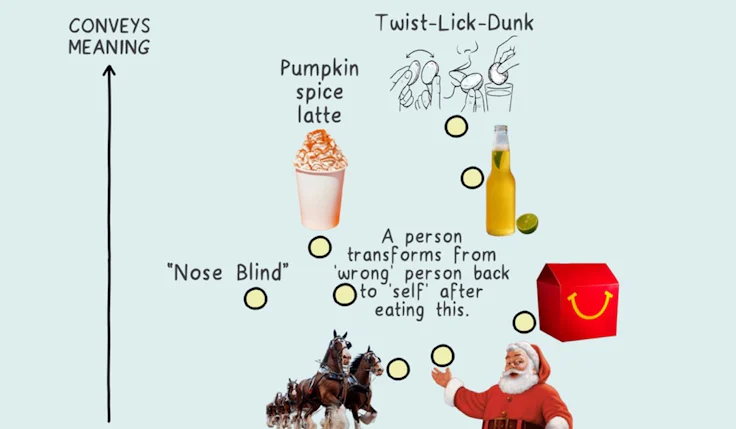
Some of the top performing need codes in the research included Oreo’s ‘Twist, Lick and Dunk’ slogan. Some 89% of the sample correctly recalled the brand when showed this asset, meaning it performs well on unique. Over two-thirds also associated it with a category entry point or consumer occasion, in this case “a cookie to have with milk”.
Similarly, when shown a person transforming back to themselves after eating a Snickers, 76% of the sample correctly identified the brand (uniqueness), while 51% said the chocolate bar is “a snack that gets me back to my best when I’m hungry” (category entry point link).
There was also a strong link between Coca-Cola’s Santa and “a drink for Christmas” (41%), as well as Febreze’s “nose blind” and a product “to eliminate odour” (51%).
Big brands that have invested over the years to establish strong me codes have an advantage when it comes to developing need codes. They can create need codes that are automatically linked with the brand by leveraging their me codes.
For example, Guinness has used its distinctive product shape and colour combination to link it to particular occasions. One way it did this was pictures of black and white surfboards on a beach linking the stout to summer.
 Smaller brands
 Smaller brands
Unlike big brands, small brands do not have the luxury of leveraging well-established me codes. They also can’t necessarily afford to invest in me codes and need codes in parallel.
New brands need to focus on marketing activity that will deliver some early sales success, attract further investment and generate cash to re-invest in the brand.
This is why they might do best to focus on one category entry point to start with. Ideally, one that isn’t dominated by any big established brands, yet big enough for the brand to reach its sales targets should it succeed. They should then develop brand codes that help the brand become known for that category entry point. Once the brand has established a foot in the door via one category entry point, it can go on to cater for more category entry points via new products and need codes, building on the positive memories and good will it has already created.
As Romaniuk points out, investing in a brand code with intrinsic meaning may prove limiting in the long run, but if it helps get the brand off the ground quickly it may be the right thing to do. Distinctiveness should always be the priority, but if a brand code will also help people remember the brand in relation to a need – without being too limiting in future – it may be the best option.
Dan White is a brand strategist and author, and Jiri Boudal is the CEO of insights agency Behavio.