‘Partners not opposites’: Loveholidays on balancing performance with brand to ‘grab attention’
As Loveholidays shifts from a performance-only model to a brand-building strategy, CMO Alan Murray outlines how the brand is experimenting with creative activations and rebalancing its funnel.
Online travel agent Loveholidays has been on a journey to embed a “challenger-brand mentality” by stepping up investment in brand marketing and moving from product-focused to “emotional” marketing.
“Brand and performance are partners rather than opposites,” says CMO Alan Murray. “A key part of the journey has been helping the wider business, including finance, understand that.”
Murray joined the company from Booking.com in 2022 with a performance marketing background. At that time, Loveholidays, which sells holiday packages, including flights and hotels and competes with the likes of Jet2holidays and TUI, had no brand team at all.
Did Jet2’s unplanned TikTok virality have a positive impact on the brand?
“When I arrived, we were 100% performance marketing,” he says. “It was very clear to me, my boss, even the CFO, that we needed to start introducing some brand and figure out the right way to do it.”
Since then, Loveholidays has been slowly testing the impact of more brand campaigns, while cautiously expanding the team.
“There’s a lot of temptation for us to have a big brand budget very early,” he explains. “But we want to make sure we understand how it works for us, when it works, which situations it makes sense for, and you have to play with it in the wild for a while before you can really grow it.”
Moving beyond performance
Early 2023 marked the first move beyond pure performance marketing, with a geo-test in Scotland followed by the Northwest, measuring impact against the rest of the UK. The business followed that test with its first national brand campaign in 2024, aimed at boosting awareness and purchase intent across digital, radio, OOH, paid social and influencer activity.
“Where we started out was very rational and product-centric. Last year, we really tried to add in some emotional connection with the consumer,” he adds.
More recently, the brand has taken this to the next level with the goal of “grabbing attention”.
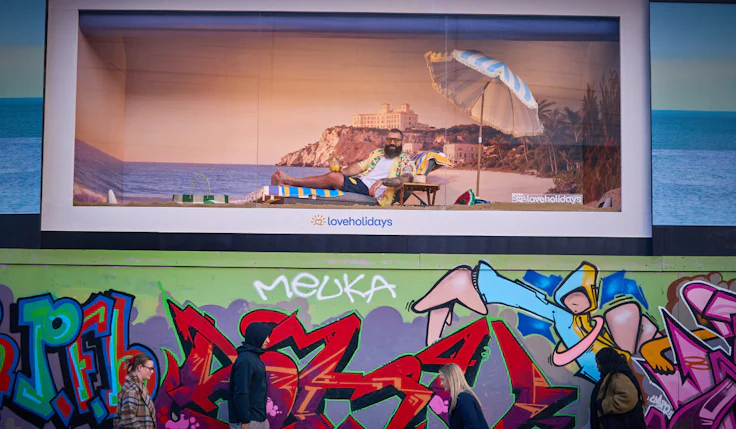
It unveiled an interactive billboard outside Shoreditch station. Celebrity Traitors contestant and former England rugby player Joe Marler opened the activation, appearing on a sun lounger, reading and building sandcastles as commuters passed. Actors occupied the billboard throughout the week.
The installation aimed to highlight how dark winter months affect Brits’ wellbeing and tapped into the role holidays play as a mood-booster.
“We’re just trying to show up with something a bit more unexpected, leverage a bit more humour, and try and grab some attention,” he explains. “Our budgets aren’t the biggest in our industry, so we’ve got to go a bit further with the creative.”
@shainagordon I was questioning if it was real ……. It’s reallllll !! #fyp #loveholidays #shainagordon #marketingtiktok @loveholidays
Created in partnership with independent creative agency Ark, the stunt quickly gained traction on social media, with users debating whether Marler was a hologram, looping video or a committed actor.
“The billboard alone was never going to do that [gain traction], if the only people who ever saw it were the people walking past it. So it really had to be something that we either stimulate ourselves or together with the influencers,” he explains.
The activation supported the brand’s Black Friday campaign, marking the first time Loveholidays has layered brand activity over sales promotion. The aim is to shift more consumers into a “holiday mindset”.
“We can connect the dots through our performance marketing and fill that funnel from top to bottom,” he says, noting that it has taken a “mindset shift” in the business to understand that if money gets put into brand, it won’t necessarily be seen the same day.
“The fact that we started with geo-testing, we’re now building out our MMM, we can start to have an informed conversation with the finance team over time of ‘look, I know you can’t see it on a Saturday, if I spend more money that I get more revenue on a Sunday, but here’s well grounded statistical evidence that this thing is good for you, it’s good for us, and by the way, it’s fun,'” he says.
Paid social is very hard to understand. For example, if we’re losing, we’re losing out to Maybelline, how do I deal with that?
Alan Murray, Loveholidays
As well as investing more of its budget in brand, Loveholidays is also investing in people. The brand team has grown to eight across PR, social and brand, alongside new creative, media and influencer agencies.
And although the team has grown, Murray notes it doesn’t necessarily have a goal to be as big as it can because “size comes with complexity and everyone has to align”.
Meanwhile, Loveholidays has big plans for 2026, according to Murray. The first is to continue implementing a “challenger-brand mentality” by feeding the top of funnel.
“Brand and performance are complements, not substitutes, so the more that we can start to justify reinvestment in brand, the more that helps our performance marketing,” he explains.
He claims the business has already seen “phenomenal” gains, including a 30% jump in awareness over two years, with trust and consideration also rising. Scaling this is a priority for the year ahead. This aligns with figures from YouGov, which finds Loveholidays’ awareness has grown from 20% in 2022 to over 32% this month.
Ryanair closes loyalty programme after eight months
The company also plans to shift parts of its performance strategy from search to paid social.
“We know we’re just competing against the same people from the same industry, trying to do the same thing with the customer on search. Paid social is very hard to understand. For example, if we’re losing, we’re losing out to Maybelline, how do I deal with that? It’s a completely different story,” he explains.
Murray adds that Loveholidays has also made strong progress on AI and automation, enabling the team to deliver “a tremendous” amount more.
For instance, its bidding processes in media buying are now automated. Previously, the team manually downloaded and analysed bid data in Excel, which has been a “tremendous saving,” Murray notes.
The brand has also streamlined content production, including using AI to write hotel description summaries.
“We used to have 52,000 hotels on our site, so writing a really detailed brief of the content on each of those, for all of them, takes an army,” he explains.
“We used to have to rely on supplier content a lot, but now we’ve got a more editing, supported by AI, which is fantastic.”