How a heritage cruise brand used a hybrid AI approach to make a splash
Fred Olsen Cruise Lines used a hybrid AI approach for its latest campaign to create efficiencies without sacrificing its human touch.
The cruise category has never been short on spectacle in its communications. Sun-drenched decks, dramatic destinations and smiling passengers have long been the visual identity of an industry that sells an escape at sea. Yet for all that stunning imagery, differentiation remains a persistent problem.
For consumers, particularly those new to cruising, brands can quickly blur into one another. While, for marketers, the challenge is how to cut through that “sea of sameness” – excuse the pun – without resorting to cheap gimmicks that don’t reflect the real experience.
For Fred Olsen Cruise Lines, the task is even more challenging. As a family-owned, UK-based heritage brand with just three ships, it competes against global cruise giants with far deeper pockets and louder voices. But according to head of brand marketing, Holly Goddard, that imbalance can also be a strength.
“We’ve always been very clear on who we are,” Goddard says. “Fred Olsen is about people first. That’s our crew, our guests, the human interactions on board. Any marketing we do has to reflect that, otherwise it just doesn’t feel authentic.”
That belief sits at the heart of its new brand campaign, which blends traditional live-action production with AI. A hybrid approach that seeks to capture the best of both worlds: stretching budgets, maintaining creative standards and helping the brand punch above its weight in a competitive category.
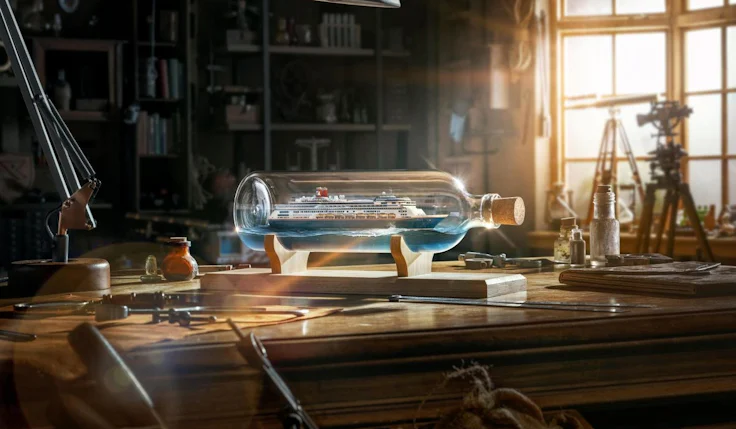
Former Compare the Market marketing boss joins Fred Olsen Cruise Lines as CMOThe idea took shape during the pitch process. Working with Blunt House, which assembles bespoke teams rather than relying on a single in-house agency model, Fred Olsen was presented with a strong creative narrative for a new TV campaign, a twist on a ship in a bottle. From the outset, Goddard was sold on the emotional direction.
“It was one of those moments where you see the idea and you immediately believe in it,” she says. “You can picture how it could bring the brand to life.”
But belief alone does not pay production bills. The scale of the creative ambition raised an obvious question: how could it be delivered?
That was where production partner Nmatic.ai, led by CEO Nick Price, entered the conversation. With decades of experience in traditional broadcast and advertising production, Price was quick to recognise that a conventional approach would push the campaign well beyond budget.
“If we’d done this in the old way, you’d be talking about a very expensive shoot,” Price says. “So the real challenge was identifying where AI and CGI could remove cost without removing quality.”
The answer was not to make everything with AI. Instead, the campaign was designed as a hybrid: real people, real moments and real emotion captured on camera, combined with AI and CGI used selectively to enhance environments, transitions and scale.
For Goddard, that distinction mattered. She describes AI as a “specialism” that should be brought in “where it genuinely adds value, not just because it’s fashionable”.
One of the clearest red lines from Fred Olsen was that all people featured in the campaign had to be real. No synthetic passengers, no AI-generated crew.
“That was non-negotiable,” Goddard says. “You can’t fake the kind of warmth and care that our guests experience on board. That comes from real people, and it’s a huge part of why guests cruise with us time and time again.”
From service department to ‘beating heart’: Why one brand is doubling its marketing teamPrice agrees that this principle anchored the work. “There’s a tendency in the industry to think it’s all AI or nothing,” he says. “But that’s not how technology ever really settles. Just like CGI, it finds its place. For Fred Olsen, AI’s place was around environments and production efficiencies, not replacing human presence.”
That balance also made the work easier to sign off internally. Despite Fred Olsen’s long history, Goddard says there was little resistance to the idea of using AI as part of the production process. Under CEO Samantha Stimpson, who joined just over two years ago, the business has clear ambitions for growth and modernisation. The appointment of former Compare The Market CMO Mark Vile in November as its CMO also speaks to that ambition.
“[Stimpson] loved the concept,” Goddard says. “Technology and efficiency are core pillars of how we want to grow as a business.”
The bigger challenge came later, during the production itself. Hybrid workflows require a leap of faith, particularly when early edits include placeholder transitions or unfinished CGI.
“There were moments where I had to say to colleagues, ‘This isn’t the final version yet,’” Goddard admits. “Some things were still being built. That requires trust in the process.”
That trust paid off when the final edit was delivered. “It made the end result even more special,” she says. “When everyone finally saw it come together, it was a proud moment.”
Stretch further
While AI is often discussed in terms of cost cutting, Goddard is clear the real benefit for Fred Olsen was the ability to do more, not less. Budgets remain under pressure across the industry, of course, but expectations for brands to be across every channel continue to rise.
“What this approach allowed us to do was stretch further,” she says. “More touchpoints, more variations, more thought at every stage of the funnel.”
The campaign extends far beyond a single TV execution, with radio, print, extensive photography and more than 100 digital video variations, many tailored by destination, all playing a role. Each asset was designed to feel part of a coherent whole, rather than an afterthought to the TV ad.
“Too often, all the focus goes on the TVC,” Goddard says. “This time, we really thought about every touchpoint. How does this idea live across channels? How does it work for different destinations? How does it support people at different stages of consideration?”
‘We are going to shake things up’: Virgin Voyages on enticing a different type of traveller to cruisingThat level of detail matters in a category as crowded as cruising, particularly during ‘wave’ season, when brands flood the market with offers and promotions. For Goddard, the aim was not just to be seen, but to be remembered.
“It’s very easy for cruise advertising to blur into one,” she says. “We wanted something that reflected our character and charm, with real depth and storytelling.”
Early indicators suggest the approach is working. Brand searches are up 15% year on year, and System1 delivered the ad a 4.8-star rating – a significant uplift on the brand’s previous TV advertising.
“That was a huge vote of confidence,” Goddard says. “It showed that the emotional story was landing.”
Sales impact will continue to play out as the campaign runs through to the end of March, but for Goddard, brand metrics are just as important. “If you don’t stand out at the top of the funnel, you don’t get the chance further down.”
A digital twin
One of the most ambitious elements of the campaign was the creation of a full digital twin of Fred Olsen’s flagship ship, Bolette, which Park believes is one of the largest AI-ready digital twins of its kind. Built using extensive drone capture and mapping, the twin recreates the ship in minute detail.
“For us, it had to be 100% accurate,” Goddard says. “People notice the smallest inconsistencies, whether that’s guests, colleagues or the Olsen family themselves.”
Price explains that the process was closer to traditional CGI than off-the-shelf AI replication. “Once you have that digital twin, it becomes an incredibly powerful asset,” he says. “You can place the ship anywhere in the world, at any time of year, from any angle.”
For Fred Olsen, the long-term value of the asset lies in both creativity and efficiency.
“We now have a ship we can put in any port, in any season,” she explains. “That’s hugely valuable when you’re marketing itineraries all over the world and need fresh content all the time.”
Technology, however, is only part of the picture. Goddard is clear that Fred Olsen’s wider brand strategy remains rooted in simplicity and trust. Cruising can be overwhelming, particularly for first-timers faced with a dizzying array of ships, destinations and cabin categories.
“Our job is to make it easy,” she says. “Easy to understand what you’re buying, easy to book, easy to feel confident in your choice.”
Winning hearts, minds and models: Brand building in an AI worldThat confidence is underpinned by strong fundamentals: high repeat rates, a significant solo traveller audience and an NPS score of 66. “The product is genuinely liked,” Goddard says. “Marketing’s role is to make sure that comes through clearly.”
Looking ahead, both Goddard and Price believe AI will become a normalised part of travel marketing, rather than a headline in its own right. “There’s a lot of fear because it’s moved so fast,” he says. “But in the right hands, it’s just another tool – a very powerful one.”
He expects AI to enable more ambitious creative and greater personalisation, while lowering barriers for smaller brands. Goddard agrees, with a note of caution.
“You can’t be left behind,” she says. “But you also have to put yourself in the customer’s shoes. For our demographic, trust is everything.”
For Fred Olsen, that balance – between innovation and authenticity, efficiency and emotion – is what defines the campaign.
“This technology helps us move forward,” Goddard says. “But only because we’re clear on who we are and what we stand for.”